Font License Violations: The 5 Most Common Mistakes
Many brands and designers see fonts as a purely aesthetic choice. In reality, fonts are both a design work and a software product protected by copyright law. Misusing them—or worse, using them without a license—can result in lawsuits, six-figure settlements, halted campaigns, and reputational damage.
Here are the five most common mistakes companies make when it comes to font licensing, along with practical ways to avoid them.
1. Using Fonts Without a License
The most frequent mistake is assuming that a font downloaded online is automatically “free.”
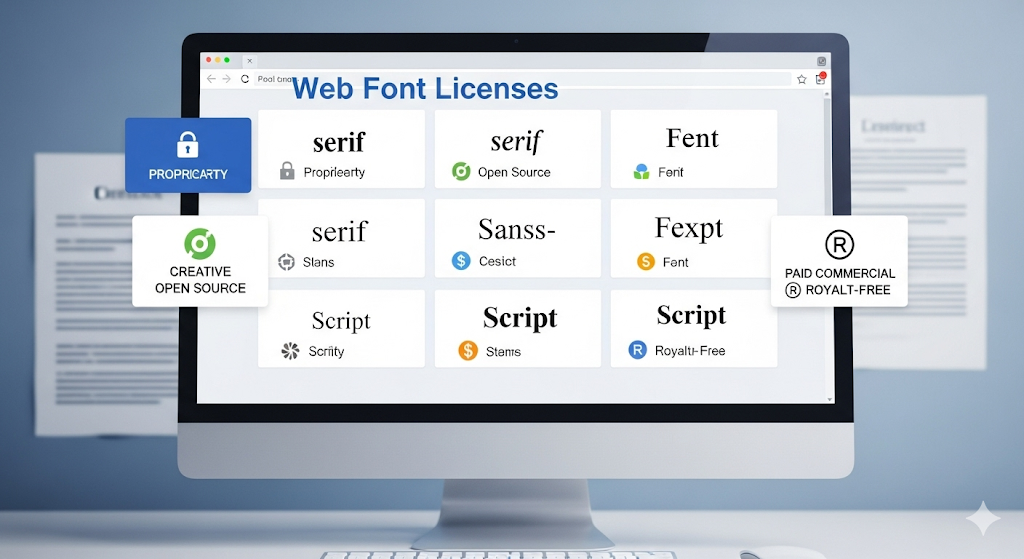
Every font is protected by an End User License Agreement (EULA).
Fonts labeled “Free for personal use” are not legally permitted for commercial use.
Overlooking this clause is one of the costliest errors.
Example: A designer delivers a logo to a company using what they believed was a free font. Months later, it turns out the font requires a commercial license. The company is forced to pay retroactive licensing fees and redesign costs.
Solution: Always review the license documentation. Even fonts advertised as “free” may have restrictions.
2. Purchasing the Wrong License Type
Buying a license is not enough—the type of license matters.
Desktop license: Covers use in applications like Word, Photoshop, or InDesign, as well as printed materials.
Web license: Required for embedding fonts on websites, often priced by monthly page views.
App license: Needed for embedding fonts in mobile apps.
Logo license: Some fonts require additional permission for trademarked logos.
Example: CBS Television bought a desktop license but also used the font in broadcast graphics and online platforms. The result was a costly infringement case.
Solution: Match the license type with your intended use—print, web, app, or logo.
3. Failing to Secure License Transfer from Agencies
Another common misconception is that if an agency or freelancer uses a licensed font, the brand automatically inherits the license.
Licenses belong to the purchaser—not to the client by default.
An agency’s license is valid only for their use.
Brands must hold their own licenses for legal security.
Example: A Swiss financial firm was sued for using unlicensed fonts in brochures prepared by an agency. The agency denied responsibility, and the penalty fell on the company.
Solution: Include clear clauses in contracts requiring agencies to deliver font licenses and proof of purchase.
4. Misusing Google Fonts
Google Fonts is often considered “safe” because it’s free and widely used—but misuse can still trigger legal and operational risks.
When fonts are served directly from Google’s servers, visitors’ IP addresses are transmitted to Google.
In the EU, this can be classified as a GDPR violation. Several German websites have already been fined.
Over-reliance on popular Google Fonts (Roboto, Open Sans, Montserrat) can also dilute brand uniqueness.
Solution: Self-host Google Fonts on your own server. This ensures GDPR compliance, faster site performance, and brand control.
5. Failing to Archive License Documents
Purchasing a license but not keeping records is another frequent oversight.
Even if you have legally purchased a license, without invoices or EULAs you may be treated as an infringer.
Courts and auditors require proof, and the burden is always on the company.
Lost documents can mean losing your legal defense.
Solution: Store all font invoices, EULAs, and license files in a central, accessible archive. Include purchase date, license type, and usage scope.
Font licensing mistakes are far from trivial—they can cost companies hundreds of thousands of euros or dollars, delay critical campaigns, and permanently harm brand reputation.
Avoiding these five common errors—unlicensed use, wrong license type, unclear agency agreements, misuse of Google Fonts, and poor documentation—can save your company from expensive lawsuits and operational crises.
Proper licensing and regular audits aren’t just legal necessities; they are vital elements of risk management and brand protection.