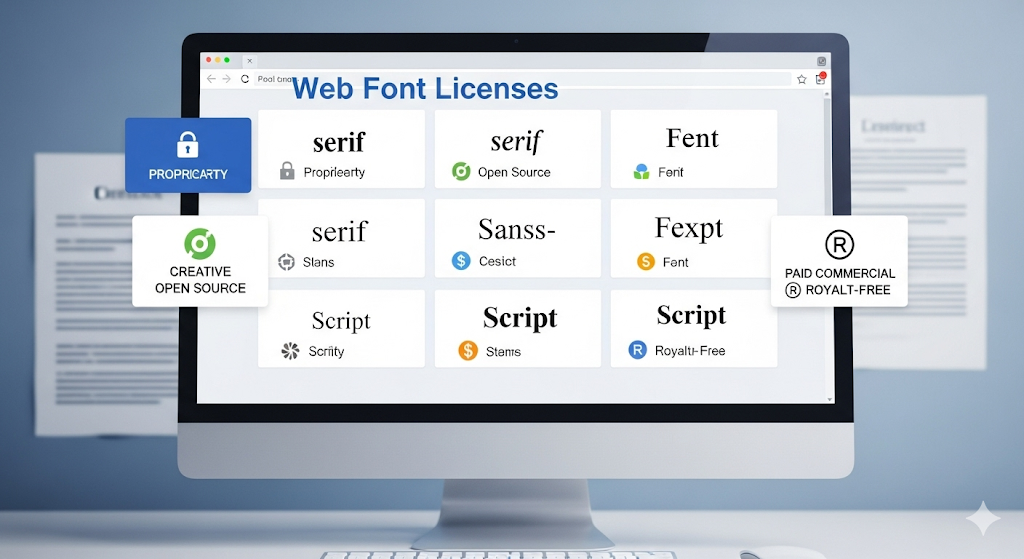
Font Licensing Responsibilities Between Agencies and Clients
In visual design and brand communication, fonts are far more than just an aesthetic choice — they also carry legal obligations. The way a font is purchased, licensed, and used can determine whether a project stays compliant or faces unexpected legal and financial risks. For this reason, understanding the division of responsibilities between agencies and clients is crucial.
1. Font Ownership and Licensing Scope
Every font comes with its own licensing rules.
Usage Rights: Some fonts are licensed only for personal use, while others require separate fees for commercial use.
Scope: Licenses may cover desktop design, web embedding, mobile apps, publishing, or enterprise-wide distribution.
Ownership: An agency’s license usually covers only its own team. Clients cannot automatically inherit
or use that license unless the terms allow it.
2. Agency Responsibilities
Agencies are the professional side of the collaboration and are expected to guide clients properly.
Proper Licensing: Agencies must ensure that even trial or presentation designs use legally licensed fonts.
Transparency: They should clearly inform clients which fonts are used, what type of license applies, and any additional costs involved.
Avoiding Temporary Fixes: Fonts used in mock-ups without a license must never appear in the final deliverables.
3. Client Responsibilities
Since clients own the final product, they carry the responsibility for long-term font usage.
Purchasing Licenses: Clients are responsible for buying the correct licenses for websites, brand identities, marketing materials, or apps.
Managing Distribution: If fonts are shared with employees or external partners, clients must ensure this is permitted under the license.
Providing Legal Access: If a client already owns a corporate font license, they must provide it to the agency in a way that complies with the license terms.
4. What to Define in Contracts
Ambiguity in font licensing can lead to disputes. To prevent this, contracts between agencies and clients should include dedicated clauses, such as:
Who will cover the cost of font licenses?
Does the agency’s license cover only the design process, or does it extend to the client’s final usage?
If the client has a corporate font license, can the agency legally use it during the project?
5. Potential Risks
Failure to respect font licensing can have serious consequences:
Financial Penalties: Fines for unlicensed usage can reach thousands of dollars or euros.
Reputation Damage: High-profile cases of copyright infringement can harm brand credibility.
Project Delays: Legal issues may delay the launch of websites, apps, or campaigns.
6. Example Scenarios
Scenario 1: An agency designs a logo with a font they are licensed to use internally. However, because the license doesn’t transfer to the client, the client cannot legally use the logo unless they purchase their own license.
Scenario 2: A client has a corporate font license for internal use. The agency needs to use the same font during the design phase, but the license doesn’t allow external vendors. Unless the client extends the license, this creates a compliance issue.
Scenario 3: A free font is used for a website design, but the license excludes web embedding. Even though the font was free, its use on the client’s site becomes a legal violation.
Font licensing may seem like a small detail, but unclear responsibilities can result in costly consequences. The safest approach is for agencies and clients to clarify responsibilities at the start of every project and document them in the contract.
Tip: Create a simple “font licensing checklist” at the beginning of the collaboration. This ensures that both sides are legally protected and aligned on responsibilities.