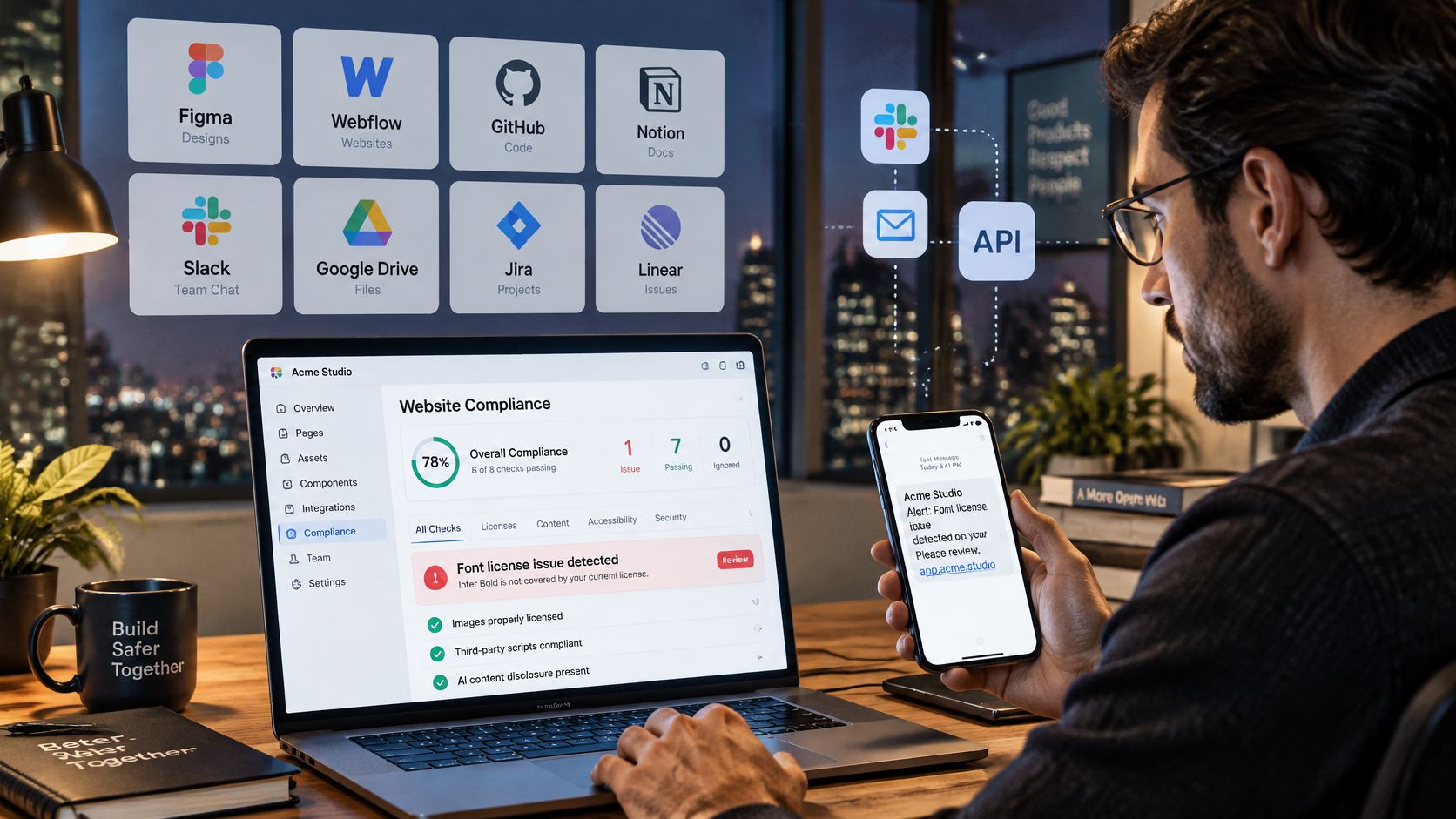
A scheduled audit runs at 2 a.m. and flags an expired webfont on a live client site, or a self-hosted file nobody on the current team remembers licensing. If that finding sits in an inbox until Monday, you've got a harder conversation with the client and, potentially, the foundry. If the right person gets a text in minutes, it's usually a fix, a record update, or a pause before a campaign ships.
That gap is why compliance-aware teams care about the best text alerts tools, not just the fastest sender. SMS itself has the reach for this job. The history of SMS on Wikipedia notes the first message was sent on December 3, 1992, when engineer Neil Papworth sent "Merry Christmas" to an Orbitel 901 handset that couldn't reply. Modern two-way alerts are a different operational tool entirely.
This comparison is informational only, not legal advice. I evaluated each pick on integrations (Slack, email, API), deliverability, audit trail, and fit for in-house teams versus agencies. The same discipline applies if you're reviewing compliance responsibilities in outsourced security operations. Outsourcing the send doesn't outsource accountability for who was notified, when, and what happened next.
1. Twilio Programmable Messaging

If your alert has to fire from application logic, start here. Twilio's Programmable Messaging API lets you send and receive SMS and MMS through REST calls or SDKs, route through carrier networks in many countries, and tie every message to the event that triggered it. That's why teams use it for two-factor codes, incident notifications, and CI-driven escalations.
Say a scheduled font audit finds a lapsed typeface on a production domain. Your backend can text the designated compliance contact with the domain, font family, and expiry date, then log the message ID against that scan. Engineering on-call rotations use the same pattern when a front-end performance budget fails in a build.
Measure Delivery, Not Imaginary Opens
Don't judge Twilio, or any SMS tool, on open rate. The SMS.to comparison of SMS and email marketing explains that SMS generally lacks a read receipt, so delivery only confirms the handset received it. Its Klaviyo-derived bands class click-through below 5.9% as critical and 14.6% or higher as top-tier, which gives you a more honest test.
Track delivery, clicks, acknowledgement, and remediation separately. One clear action per text beats a paragraph of context.
- Register for US 10DLC early: Brand and campaign registration reduces carrier filtering before launch.
- Log every status change: Store message IDs and delivery states so legal can reconstruct the timeline.
- Keep content clean: Name the asset and deadline, but don't put sensitive client data in the text.
Practical rule: If you can't prove who got the alert and what they did next, you don't have an audit trail. You have a sent folder.
2. Amazon Simple Notification Service (SNS)
Teams already deep in AWS often don't need another vendor. Amazon SNS is a managed publish-subscribe service that can text phone numbers directly and fan the same event out to email, HTTP endpoints, and queues. Native CloudWatch integration makes it a natural backbone for infrastructure and application alerts.
A typical setup publishes one topic when a monitored site's font license status changes. That topic notifies on-call phones by SMS and posts to a Slack-connected email address at the same time. Infrastructure teams use the identical pattern when CloudWatch detects an error-rate spike on a web property.
Where SNS Helps and Where It Pinches
SNS is strong on fan-out and plumbing, weaker as a polished messaging product. You get topic-based routing and AWS-native permissions, but you'll build your own templating, preference handling, and reporting views. For compliance work, that trade-off can be fine if your engineers already own the pipeline.
Scale isn't the constraint. The World Economic Forum chart on global texting reports that by 2012 roughly four billion people used SMS and global volume reached about 23 billion messages per day. Your bottleneck will be routing and relevance, not whether phones can receive texts.
- Request production SMS access early: Sandbox limits block most real recipients.
- Set a monthly spend limit: A misconfigured alarm can turn into an expensive alert storm.
- Separate your topics: Keep transactional alerts apart from marketing traffic for cleaner compliance records.
I recommend SNS when your monitoring already lives in AWS and you want one publish action to reach several systems. If non-technical staff need to manage recipients themselves, you'll feel the friction quickly.
3. Vonage Messages API (formerly Nexmo)
A renewal warning that ends as an unread phone thread is weak evidence in an audit. Vonage is useful when the alert must move across channels and still come back with a receipt. The Messages API unifies SMS with WhatsApp, Messenger, and RCS, and the older Nexmo brand now sits inside that suite.
The compliance-friendly pattern is two-way. Operations sends the alert, the recipient replies to acknowledge it, and an inbound webhook writes that reply into the incident or asset system. Brand and legal teams can use the same flow for license-expiry notices: the message goes out on the recipient's reachable channel, while the acknowledgement lands where it can be searched later.
Set Interruption Rules Before You Add Channels
Multi-channel reach makes fatigue easier to create. Data cited in the Attentive 2025 UK SMS and email marketing report shows 44% of consumers look for shipping updates by text and 37% expect order confirmations, which points to operational relevance beating promotional frequency. Apply that logic internally: failed usage checks and confirmed violations can interrupt, while routine renewal reminders stay batched in business hours.
- Map fallback per alert class: Decide which incidents escalate from SMS to WhatsApp or RCS before enabling extra channels.
- Log acknowledgements by webhook: A reply in a phone thread isn't evidence your team can search later.
- Check registration per country: Sender rules differ by market, and Vonage won't erase local requirements.
Takeaway: pay for Vonage when regional channel fallback and reply capture are required; a single domestic SMS rota won't use that flexibility.
4. Plivo SMS API
A freelance designer gets a text that a font license she bought for a client project is due for renewal in seven days. She checks the purchase record, renews, and files the receipt before handoff. That small, transactional pattern is Plivo's sweet spot.
Plivo offers SMS, voice, and verification APIs with global reach and detailed delivery reporting, and developers often pick it as a cost-conscious alternative to larger platforms. Development teams also use it for deployment-status texts to release managers after production builds. It won't give you an incident-management layer, but for direct transactional alerts it covers the essentials cleanly.
The Licensing Detail Your Alert Should Surface
Your message should distinguish where the font is used, because the rights aren't interchangeable. Monotype's licensing guidance describes desktop licenses as covering installation on Mac or Windows for applications like InDesign and Photoshop, while its webfont license authorizes website use and can be restricted to a single domain. A team can be compliant on desktop and noncompliant on the web with the same family.
So don't text "font problem found." Text the family, domain, and deployment type. That specificity tells the recipient which EULA to check.
- Compare per-segment pricing: Price your top three destination countries before you commit.
- Review delivery reports weekly: Carrier filtering usually shows up as a pattern, not a single failure.
- Store message IDs with the trigger: Pair each text with the scan or build event for later review.
Nothing here confirms a font is free or safe to use. Plivo delivers the warning. The EULA and purchase record decide the answer.
5. Sinch Engage (SMS and Messaging APIs)
High volume across many markets changes the evaluation. Sinch is built for enterprises that send large numbers of alerts and need consistent delivery through established carrier relationships, alongside voice, email, and verification services. For a multinational brand audit, that consistency matters more than a slick dashboard.
Ask the carrier question first: where did the message land? A global scan flagging unlicensed typefaces on a local-language site in one region can trigger a regional SMS alert to that market's owner, while webhook callbacks write delivery status back for client or internal reporting. Agencies use those callbacks to show not just that an alert was sent, but what the carrier returned. That return path is what makes the notification defensible months later, when someone asks whether a specific market was warned.
What Delivered Means at Each Carrier Hop
Delivery reports should separate queued, carrier-accepted, and delivered states. The FCC 2025 modernization proceeding for national alerting systems raises whether alerts should guarantee delivery or operate on a "best effort" basis, and it discusses resilience during outages. It also sets a geographic targeting expectation of no more than 0.1 mile of overshoot where technically capable for Wireless Emergency Alerts.
You're not running emergency alerts, but borrow the questions. Can Sinch distinguish queued, carrier-accepted, and delivered for your routes? What happens with roaming or recycled numbers? A "delivered" label that collapses those states hides the exact failures your audit trail needs to show.
- Demand country-level delivery data: Ask for a report by market before signing a volume commitment.
- Map sender IDs per market: Unregistered senders get rejected or rewritten in several countries.
- Wire webhooks on day one: Delivery failures your team can't see become silent compliance gaps.
At enterprise scale, the platform you want is the one that shows you, country by country, where messages landed.
6. Infobip Messaging Platform
Infobip centralizes SMS, RCS, WhatsApp, and voice for businesses sending at scale across many countries, with delivery and compliance managed under one platform. Enterprises use it for multi-country SMS and WhatsApp alerts when scheduled website audits flag license problems. Retail brands use scenario-based messaging when a product page fails a performance threshold.
That central control helps agencies running similar alert workflows for several clients. Templates, opt-in records, and channel rules live in one place instead of being rebuilt per account. The risk is the opposite of a raw API. You'll work inside Infobip's model for scenarios and reporting, so check it matches how your team already escalates.
Pageview Thresholds Make Good Alert Triggers
Some font risk is a counter, not a file. The MyFonts FAQ gives an example annual webfont package at 250,000 pageviews per month, after which the customer must buy a higher tier. It also states a company desktop license doesn't cover webfont use, mobile-app embedding, or digital advertising.
That's an alertable threshold. Text the account owner before a campaign pushes a client site over its allowance, not after the invoice or complaint arrives.
- Template by country: Wording, sender, and opt-out rules vary, so don't reuse one global message blindly.
- Start with one channel: Prove SMS delivery before adding WhatsApp or RCS fallback.
- Review opt-in records regularly: Centralized sending needs centralized consent evidence for audit readiness.
Infobip fits when multi-country governance is the problem. For a single-market team, its breadth may be more platform than you need.
7. PagerDuty Incident Alerts
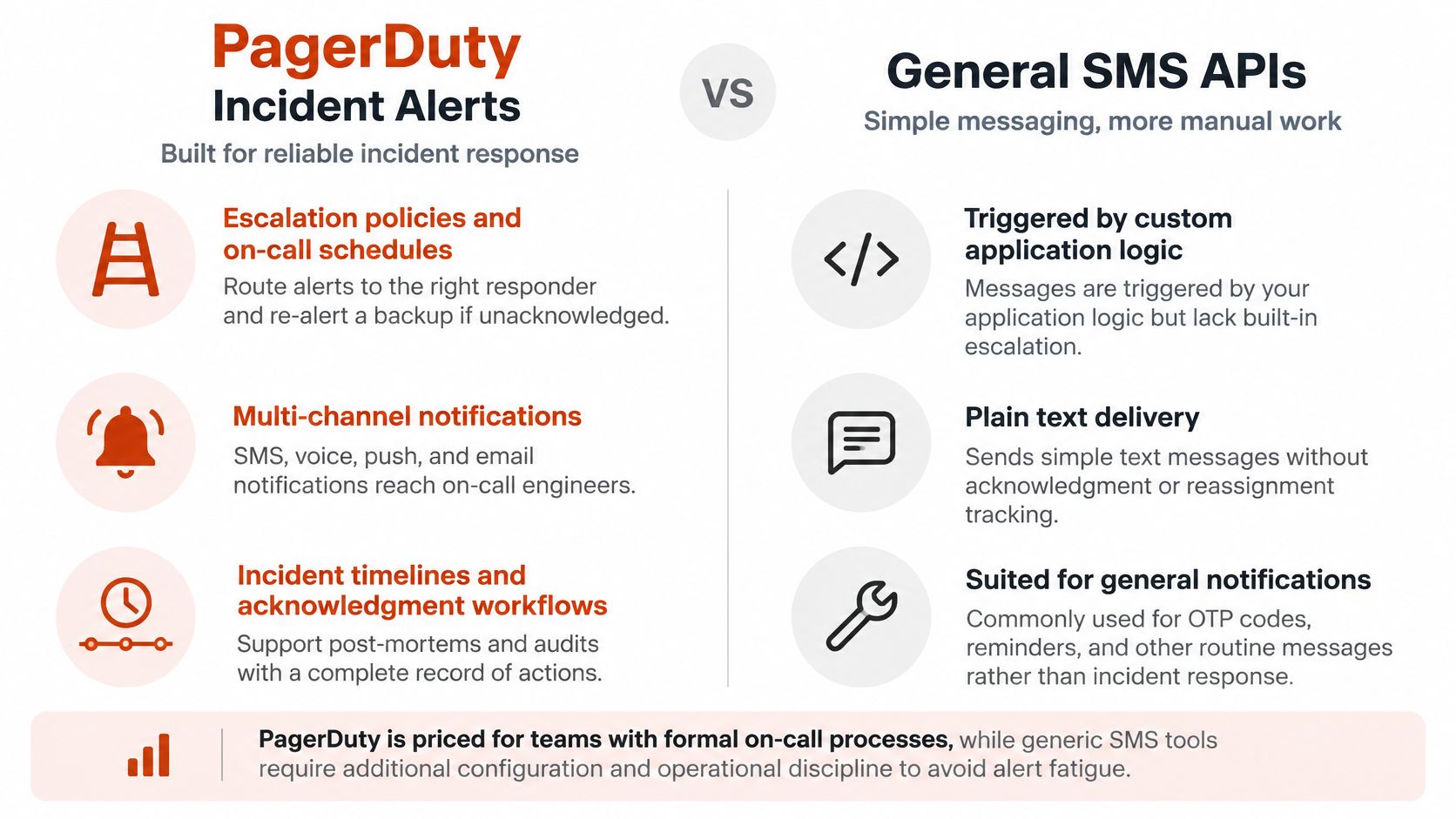
PagerDuty isn't a general SMS API, and that's the point. It routes SMS, phone, push, and email alerts to on-call responders, escalates when nobody acknowledges, and tracks response times. You buy it for who gets woken up and what happens if they don't respond, not for cheap message volume.
Front-end teams receive escalations when a CI performance check reports payload regressions on a production page. Operations teams use escalation policies to notify a backup responder when a scheduled scan reports a rogue font. The same routing discipline helps teams spot server slowdowns before downtime, because the alert path is already owned and tested.
The comparison below shows where an incident platform diverges from a raw messaging API.
Specific Beats Loud
A page that says "font issue" will be ignored by the third occurrence. A 2026 qualitative study indexed in the ACM Digital Library examined 37 participants in a high-frequency alert environment averaging 80 messages per day and found a vague "Civil Defense" message received only 16.2% positive evaluations. Messages with all five evaluated warning elements scored highest.
Write PagerDuty alerts with event, asset, severity, action, and deadline. Something like "Critical, Acme Sans license expires in 7 days on example.com, renew or replace before 30 June, review report" gives the responder a job, not a mystery.
- Set severity thresholds: Minor findings belong in Slack or email, not as pages.
- Match escalation timeouts to reality: Base them on your team's actual response expectations.
- Review timelines monthly: Repeated alerts usually mean a deduplication or ownership problem upstream.
Chrome's guidance also matters for performance pages. The Lighthouse font-display documentation defines FOIT as a flash of invisible text and notes that swap, fallback, and optional values can replace it with FOUT, which can affect Cumulative Layout Shift. Page on sustained regressions, not every fallback flicker.
8. EZ Texting
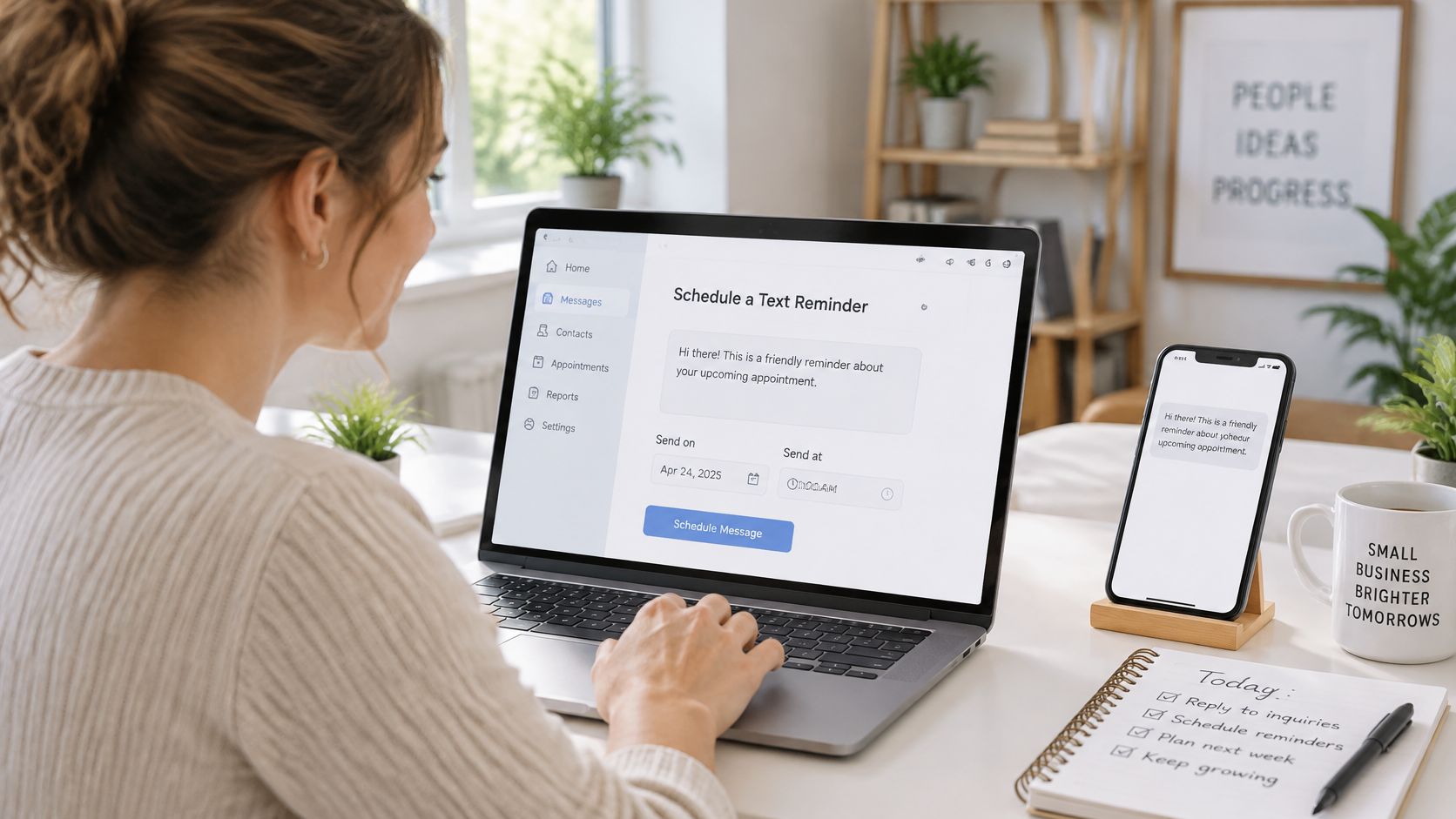
Not every alert workflow needs a developer. EZ Texting gives small and mid-sized businesses a web dashboard, contact management, and scheduling for SMS alerts, reminders, and broadcasts. Account managers and office managers can run it without filing an engineering ticket.
A small agency might schedule text reminders to clients when license renewal dates approach, then send a separate internal notice when a shared asset library needs review. Groups keep those audiences apart, which matters when client-facing wording and internal escalation shouldn't mix.
Self-Hosting Is the Detail to Name
Even a simple reminder should say whether the font file sits on your server. Type Network's support guidance explains hosted licensing serves fonts through the provider's content-delivery network via a CSS link, while self-hosted licensing supplies WOFF files you upload and serve yourself. It notes self-hosting is typically more expensive and is often chosen for security or performance reasons.
Moving a file onto your own server can change the license type and pricing, so "we already have the font" isn't a compliance answer. Your reminder should prompt a check of the EULA and deployment method before publication.
- Document opt-in for every list: Keep records you can produce, not just a spreadsheet of numbers.
- Include a clear opt-out: Short messages still need an exit path for recipients.
- Separate groups by audience: Internal alerts and client reminders carry different consent and content risks.
EZ Texting is the right starting point when the sender is an account team, not an API. Its ceiling shows when you need event-driven triggers from scans, builds, or monitoring tools.
Best text alerts tools compared at a glance
Across these eight options, three columns carry the most weight in a compliance review: proof that a message left the system, what US senders must register, and how far channel coverage extends.
| Tool | Integration model | Delivery evidence for audits | US 10DLC registration | Channel scope |
|---|---|---|---|---|
| Twilio Programmable Messaging | REST API and SDKs | Message IDs and delivery-state callbacks | Required for US A2P sends | SMS and MMS |
| Amazon Simple Notification Service (SNS) | Managed pub-sub topics and AWS integrations | Delivery status per subscription endpoint | Required for US A2P sends | SMS plus fan-out to other endpoints |
| Vonage Messages API (formerly Nexmo) | Unified messaging API with inbound webhooks | Status callbacks and inbound webhooks | Required for US A2P sends | SMS, WhatsApp, Messenger, and RCS |
| Plivo SMS API | SMS API with delivery reports | Delivery reports and analytics | Required for US A2P sends | SMS, including OTP traffic |
| Sinch Engage (SMS and Messaging APIs) | REST APIs and webhooks | Webhook delivery events | Required for US A2P sends | SMS plus additional messaging APIs |
| Infobip Messaging Platform | APIs, SDKs, and visual scenario builder | Delivery reporting inside API and scenario workflows | Required for US A2P sends | Broad omnichannel coverage |
| PagerDuty Incident Alerts | Incident platform integrated with monitoring and CI tools | Acknowledgment and escalation logs | Applies to SMS alerts to US numbers | Notifications driven by escalation policies |
| EZ Texting | Web dashboard, contact lists, and selected integrations | Dashboard send history and opt-out records | Required for US A2P sends | Business SMS texting |
I'd weight the evidence column highest. A callback, delivery report, or acknowledgment log turns "we sent the alert" into a record you can attach to an incident, scan, or renewal file. Dashboard-only reporting works for small lists, but it leaves you nothing to pull into an audit trail later.
Takeaway: Pick the tool whose proof of delivery matches your audit needs. A message ID you can store beats a send confirmation you can only see on screen.
Wire the Alerts to the Audit: Your Next Steps
Ownership decides the shortlist. Developer-led teams should pick Twilio for application logic, SNS when the stack already lives in AWS, or Plivo for cost-conscious transactional alerts; each returns message IDs and delivery states you can bind to a scan, build, or incident record. Enterprises with multi-country traffic should evaluate Sinch or Infobip, on-call-driven operations belong on PagerDuty, and non-technical teams can start with EZ Texting while accepting that event-driven automation stays limited.
Whichever vendor you land on, get three questions answered before signing:
- Does the vendor retain per-message delivery receipts long enough to serve as evidence in a license dispute or client audit?
- Can webhooks or exports carry the full alert payload into your audit system, or only a truncated status code?
- How are sender IDs and delivery reporting handled in each country where you ship pages?
Then make the alert source concrete. A text that says "something changed" is weak unless the audit behind it reports which typeface, on which domain, served from where, and under what tier. Font Checker Pro supplies that trigger layer: recurring scans classify fonts by where they are served and by AI visual identification, not only by the declared font-family name, and send a Slack or email ping when a new or unapproved face appears on production, backed by a full history of every scan.
On the Pro plan, PDF, CSV, and JSON export, scheduled re-scans with email alerts, REST API access, and ticket support let you feed findings into Twilio, SNS, or PagerDuty through your own pipeline. The Enterprise plan at $149.99/month adds authenticated scanning, a scanner allowlist token for WAF, bulk queries, white-label branding, and priority ticket support. The free Hobbyist tier covers 5 scans per month on 1 domain with no card required, enough to test the workflow before committing.
The right alert stack turns a font problem into a timestamped record: what changed, who got paged, and when it was acknowledged.
One boundary stays firm wherever you route the alerts. No notification, report, or identification result grants or confirms a font license, and Font Checker Pro does not license typefaces. Verify desktop versus webfont rights, domain scope, pageview limits, and self-hosting terms against the applicable EULA with the foundry or your counsel. What the alerting setup buys you is time and evidence, so a lapse becomes a documented fix instead of a surprise.
Run a scheduled scan, catch a rogue or expired typeface before your client does, and route that finding into the text alert workflow you've just chosen. Start with the free tier at Font Checker Pro, export the report your legal and operations teams can use, and upgrade when you need automated re-scans, API access, and a defensible audit history.