A valid API token doesn't prove that your digital assets are governed. Ninety-five percent of reported API attacks came from authenticated sources, and 98% targeted external-facing APIs, according to Security Magazine's coverage of API security research. The uncomfortable lesson is that REST API use cases aren't only about moving data between applications. They can also turn scattered compliance evidence, ownership records, scan results, and policy decisions into machine-readable assets that teams can inspect and defend.
That distinction matters for typography. A font found on a live website, inside a PDF, or in a design archive isn't merely a visual choice. Its license, distribution method, deployment context, and approval history can affect designers, developers, agencies, procurement teams, and legal reviewers. This article is informational, not legal advice. Licensing conclusions require reading the applicable foundry terms and considering how the font is used.
REST API Foundations Beyond Simple CRUD
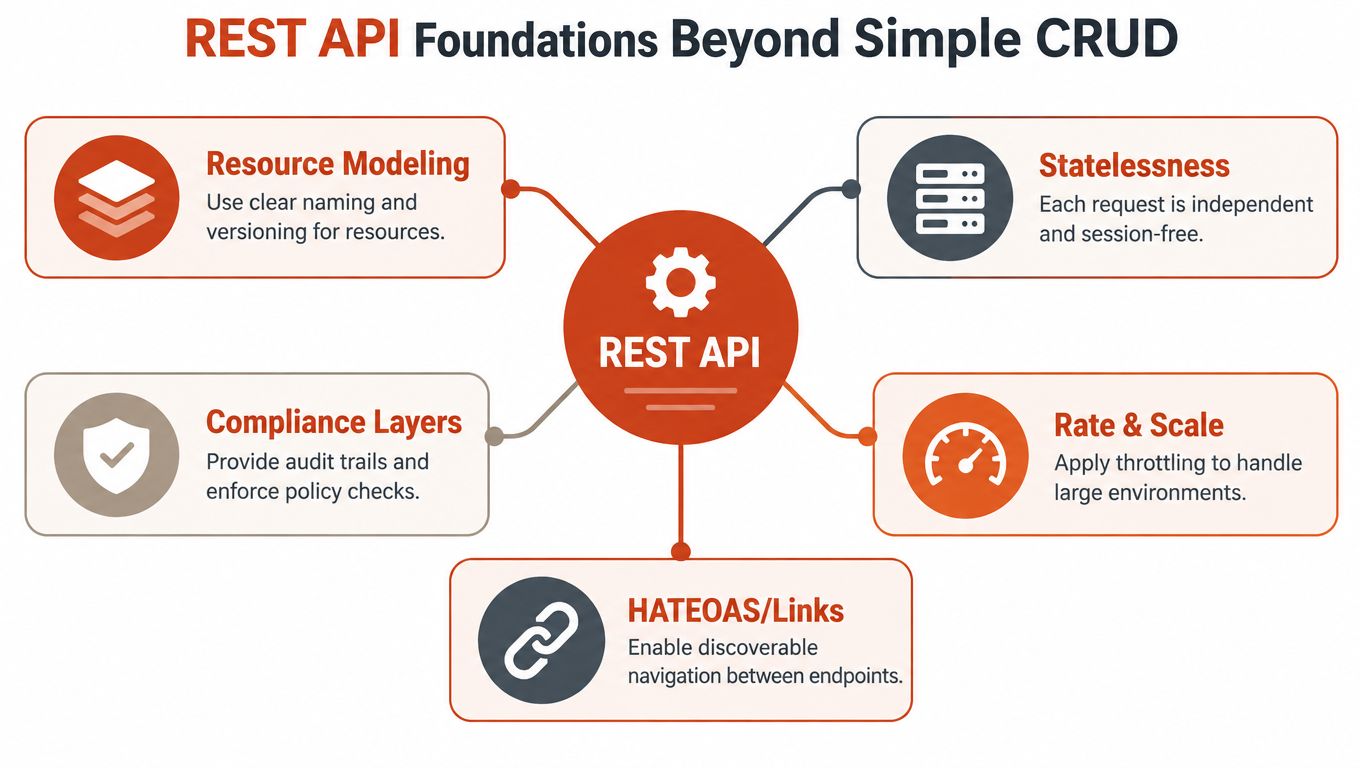
Many teams reduce REST to four database actions, but that view misses the architectural reason it works across independent systems. Roy Fielding began developing the REST architectural style between October 1994 and August 1995, while helping define HTTP/1.0 and the initial HTTP/1.1 proposal. During early development, he called it the “HTTP object model”, then changed the name to Representational State Transfer to distinguish an architectural model from a particular server implementation. Fielding formally presented REST in his 2000 University of California, Irvine doctoral dissertation, which provided vocabulary for describing the constraints behind the Web's client-server architecture. These historical details come from Fielding's dissertation evaluation.
The practical sequence is straightforward:
- Model resources: Treat a scan, font finding, license record, project, or audit event as a resource with a stable URI.
- Use a uniform interface: Let standard HTTP methods communicate intent instead of inventing a different command language for every consumer.
- Keep requests self-contained: A client should provide the context needed to process a request, rather than depending on hidden server-side session state.
- Separate responsibilities: Designers, developers, compliance staff, and external systems can evolve their own interfaces while sharing representations of the same governed asset.
- Use intermediaries deliberately: Gateways, caches, security controls, and adapters can sit between clients and services without forcing every consumer to understand the entire back end.
Why the Web model fits governance
Fielding reported that Web-based applications grew from approximately 100,000 requests per day in 1994 to 600,000,000 requests per day in 1999, a 6,000-fold increase over five years. Those are historical Web-architecture measurements, not a modern survey of REST endpoints, but they show why generic interfaces, caching, intermediary components, and substitutable implementations matter for distributed workloads. The evidence appears in Fielding's dissertation conclusions.
For governance, the important asset isn't just the response body. It's the relationship between the resource, its owner, its version, its evidence, and the action taken. A REST API can expose a finding to a ticketing system, return the evidence behind a decision, and let a CI pipeline enforce a policy without coupling all three systems to one database.
Teams that want more context on the architectural model can review how REST API design relates to protocol choices and web architecture. The useful mindset is to treat REST as a stable boundary for independently changing participants, not as a thin wrapper around tables.
Automating Font Licensing Workflows
A creative agency usually discovers licensing risk at the least convenient moment, often during a client handoff or a legal review. The agency may manage several websites, PDFs, image files, and packaged font folders, while each project has a different designer, developer, and approval history. Manual checking makes it difficult to answer a basic question consistently: which typefaces are deployed, where are they deployed, and what evidence supports their use?
Consider an agency that schedules typography audits across its client portfolio. A scan service identifies fonts on a live URL and returns structured findings. The agency's workflow then stores each finding against a client, domain, page, project, and review status. A project-management system receives an issue when a font requires investigation, while an asset library retains the report and the source context.

What the pipeline should record
A useful integration captures more than a font family name:
- Deployment evidence: Record the URL, asset path, document, or image where the typeface was detected.
- Identity details: Preserve the foundry, family, style, file format, and confidence or matching context returned by the audit.
- License context: Separate web embedding from desktop installation, application embedding, client redistribution, modification, and bundled products.
- Ownership: Assign a responsible team and a review status, rather than leaving a finding in an unowned export.
- Timing: Store scan time, license review time, expiry information when applicable, and the version of the audit process.
- Resolution: Link approval, replacement, purchase, or removal decisions to the original finding.
Font licensing depends on the specific license text and distribution method. Google's official font documentation explains that conditions are specified by each font's license and identifies the SIL Open Font License as common in its collection, alongside licenses such as Apache and Ubuntu Font License. A webfont permission shouldn't automatically be treated as permission for desktop design use, app embedding, client redistribution, or commercial packaging. This content is informational, not legal advice, and teams should review the applicable foundry terms.
Font Checker Pro can fit this workflow where a team needs scans of live URLs, PDFs, images, or zipped font sets, with reports available in PDF, CSV, and JSON formats and REST API access on Pro and Enterprise plans. The practical value comes from connecting findings to the agency's existing records, not from creating another isolated dashboard. A more detailed operational treatment is available in this font license management guide for digital agencies.
Safe Automation with Idempotency and Retries
A network timeout doesn't tell a client whether the server processed a request. That ambiguity is harmless for a read operation and dangerous for a command that creates a record, starts a scan, or charges usage. Reliable REST API use cases begin by classifying operations according to HTTP semantics before writing retry logic.
Separate reads from commands
GET, HEAD, OPTIONS, PUT, and DELETE are idempotent under HTTP semantics. Repeating the same request should produce the same intended server state, although the response metadata can differ. POST is generally non-idempotent, because repeating it can create duplicate resources or actions. PATCH isn't guaranteed to be idempotent, since the result depends on how the patch is designed. These distinctions are summarized in HTTP method guidance for REST APIs.
A practical policy looks like this:
| Operation | Default retry posture | Production control |
|---|---|---|
| Reading a finding with GET | Retry within a bounded policy | Use timeouts, backoff, and cache rules where appropriate |
| Replacing a resource with PUT | Retry when the request is safely repeatable | Validate the replacement contract |
| Deleting a resource with DELETE | Retry cautiously | Confirm the intended final state |
| Creating a scan or compliance record with POST | Don't blindly replay | Require an idempotency key |
| Applying a partial update with PATCH | Assess the patch operation | Design the patch for repeatability where possible |
For a high-value POST, the client should generate a unique idempotency key and send it with the request. The server should persist that key with the resulting response. If the client retries after a dropped connection, the server can return the original result instead of executing the scan, charge, or record creation twice.
Practical rule: Treat every timeout on a non-idempotent operation as an unknown outcome, not as proof of failure.
Make retries bounded and observable
Retry logic should honor server guidance. Clients should wait for Retry-After when supplied, stop when a rate-limit reset time is reached, and otherwise use exponential backoff with jitter. GitHub's REST API best practices describes these controls in the context of reliable API consumption.
A CI job should log the request identifier, idempotency key, attempt number, response status, and final outcome. That record lets engineers distinguish a transient transport problem from a rejected policy check. It also gives compliance teams evidence that an automated process behaved predictably.
HTTP status codes provide the shared vocabulary for those decisions. RFC 9110 defines five classes across the 100 to 599 range: 1xx informational, 2xx successful, 3xx redirection, 4xx client error, and 5xx server error. A client can therefore separate a successful request from malformed input or a server failure without parsing application-specific prose.
The goal isn't to retry everything. The goal is to retry only what can be repeated safely, preserve the identity of each command, and make unresolved outcomes visible to the people responsible for the system.
Handling Large-Scale Asset Inventories
An export that works for a small project can fail when an agency combines many client sites, recurring scans, historical findings, and font files into one inventory. The failure often starts with a convenient offset parameter. As a dataset grows or changes during traversal, offset pagination can force the database to scan and discard earlier rows, while concurrent inserts or deletions can produce duplicate or missing records.
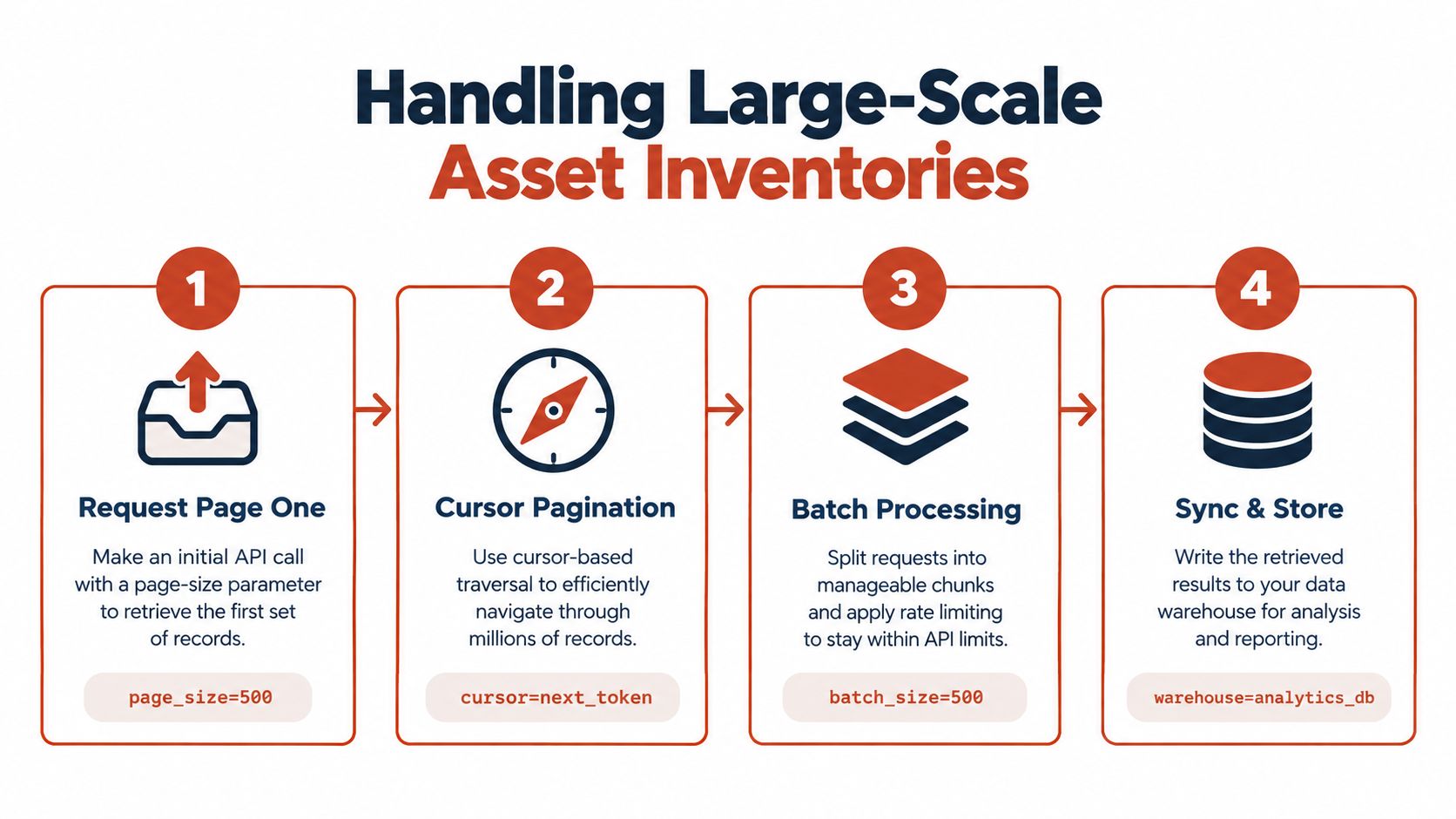
Cursor pagination gives the client an opaque continuation token tied to a stable sort position. Instead of asking for page numbers, the client follows the server's continuation link and resumes from the service's chosen position. This is better suited to audit histories, scan results, and event feeds that continue changing during export.
Build the exporter around server controls
A resilient inventory process should follow four principles:
- Follow pagination links: Don't construct the next URL manually. The server may change page size, encoding, or traversal strategy.
- Store the cursor with the batch: If processing fails after a successful page, the consumer needs a clear recovery point.
- Throttle the consumer: A batch job should regulate its request rate instead of treating the API as an unlimited database connection.
- Write incrementally: Persist findings as they arrive, with source identifiers and processing status, rather than holding the entire inventory in memory.
Rate limiting should expose permitted volume, remaining quota, and reset time, return HTTP 429 when limits are exceeded, and provide Retry-After where appropriate. These controls reduce oversized responses, database pressure, and network strain. The pagination and throttling recommendations are detailed in REST API best practices for large datasets.
Connect pagination to audit reliability
Pagination alone doesn't guarantee a correct inventory. Suppose a worker receives a page, begins transforming its findings, and loses connectivity before recording completion. The worker needs a durable batch identifier and a way to rerun processing without creating duplicate compliance records. That is where idempotent writes complement cursor traversal.
The destination should preserve the source finding identifier, scan version, client or tenant, and ingestion timestamp. A replayed page can then update the existing record or be recognized as already processed. This design separates transport progress from business completion, which prevents a cursor from falsely implying that every finding has reached the warehouse.
For large teams managing dispersed typography assets, the enterprise font license tracking guidance is useful context. The operational principle is simple: paginate with the server, batch work under explicit limits, and make every write safe to replay.
The Hidden Risks of API Authentication
Authentication answers one question: who presented the credential? It doesn't answer whether that caller may access a particular object, perform an unusual operation, export a tenant's evidence, or continue using the credential after its behavior changes.
The available evidence is stark. Only 19% of surveyed API professionals were very confident that their API inventory was accurate, while 54% relied on developer documentation to identify sensitive-data exposure. In an Asia-Pacific study covering China, India, Japan, and Australia, 37% said they had both a complete API inventory and knowledge of which APIs returned sensitive data. Those figures are reported in Salt Security's API security findings.
Authentication is only the entry gate
The first control should be scoped access. A scan worker may need permission to submit scans and read its own results, but not to alter license decisions for every client. A legal reviewer may need export access without permission to trigger large batches. Tenant boundaries must be enforced on the server, not inferred from a client-supplied field.
Runtime controls should cover:
- Object-level authorization: Check whether the caller can access this specific finding, project, report, or tenant.
- Function-level authorization: Separate permission to read, create, modify, export, and delete.
- Resource consumption: Limit expensive scans, exports, and repeated requests.
- Behavior monitoring: Alert on unusual volume, access patterns, destinations, or operation sequences.
- Inventory management: Track deployed endpoints, versions, owners, data classes, and retirement status.
- Audit logging: Record identity, object, action, decision, timestamp, and request correlation details.
Teams designing secure B2B SaaS integrations will recognize the same boundary problem. A token is a starting condition, not a complete authorization decision.
Treat the endpoint catalog as evidence
OWASP's 2023 API Security Top 10 includes Broken Object Property Level Authorization, Unrestricted Resource Consumption, Broken Function Level Authorization, Unrestricted Access to Sensitive Business Flows, Server-Side Request Forgery, Security Misconfiguration, and Improper Inventory Management, alongside authentication and authorization failures. The OWASP API Security Top 10 makes the practical message clear: a secure API needs more than token validation.
For a typography-audit workflow, the inventory should identify which endpoints submit scans, return reports, expose license metadata, and support exports. Webhook signatures need verification, API keys need scopes and rotation, and export events need a durable record. Alerts should reach the owner who can act, not disappear into a generic application log.
An audit trail guide for digital workflows helps frame the difference between a log line and defensible evidence. A useful trail connects the authenticated actor to the authorized action, the affected asset, the policy result, and the resulting state.
Turning Compliance into Machine-Readable Assets
Manual font checks produce decisions that are difficult to search, compare, or prove later. A governed REST workflow produces structured relationships: a typeface was detected in a specific asset, a license context was reviewed, an owner accepted or rejected the use, and a later scan confirmed whether the deployment changed.
That structure creates a shared source of truth for designers, developers, agencies, and legal teams. Designers can see which families are approved. Developers can block unreviewed assets in CI. Legal teams can retrieve evidence without reconstructing a project from email threads and local folders.
The same principle applies to supporting records. If teams need to convert historical agreements or review documents into structured material, a bulk PDF to Markdown converter can help prepare text for downstream indexing and analysis. The conversion step still needs validation, especially where formatting, tables, signatures, or legal wording affect interpretation.
Font governance should distinguish clearly between web and desktop use. A license that permits web embedding may not permit desktop installation, application embedding, redistribution to a client, or inclusion in a packaged product. Since licensing terms differ, this article is informational, not legal advice. Teams should retain the applicable license text and obtain professional advice when the risk or commercial context requires it.
The practical model is documented in this digital asset compliance guide for 2026. REST APIs become valuable here because they make evidence portable, queryable, and enforceable. They don't replace legal judgment. They give legal and operational teams a reliable record on which to apply it.
Font Checker Pro scans live URLs, PDFs, images, and zipped font sets, then returns exportable findings for legal review, operations, and CI workflows through JSON, CSV, and PDF reports. Use Font Checker Pro to connect recurring typography audits with ownership, license review, alerts, and an auditable asset inventory.