A campaign goes live, the landing page performs well, and the team moves on to the next launch. Weeks later, a legal notice arrives. The problem isn't unpaid crypto tax or a compromised wallet. It's an unlicensed font embedded in the campaign's hero banner, copied into a design file years ago and never recorded in the asset register.
That scenario captures the broader meaning of digital asset compliance. It includes crypto-assets, stablecoins, wallets, custody systems, and transaction records, but it also includes the digital files that carry a brand into the market. Fonts, images, illustrations, templates, and code dependencies can create separate intellectual property exposure. Compliance therefore belongs to designers, developers, marketers, finance teams, lawyers, and operations staff, not just to a specialist regulatory function.
This article is informational guidance, not legal advice. Your organization should confirm licensing obligations, regulatory classifications, reporting duties, and remediation decisions with qualified legal and compliance professionals.
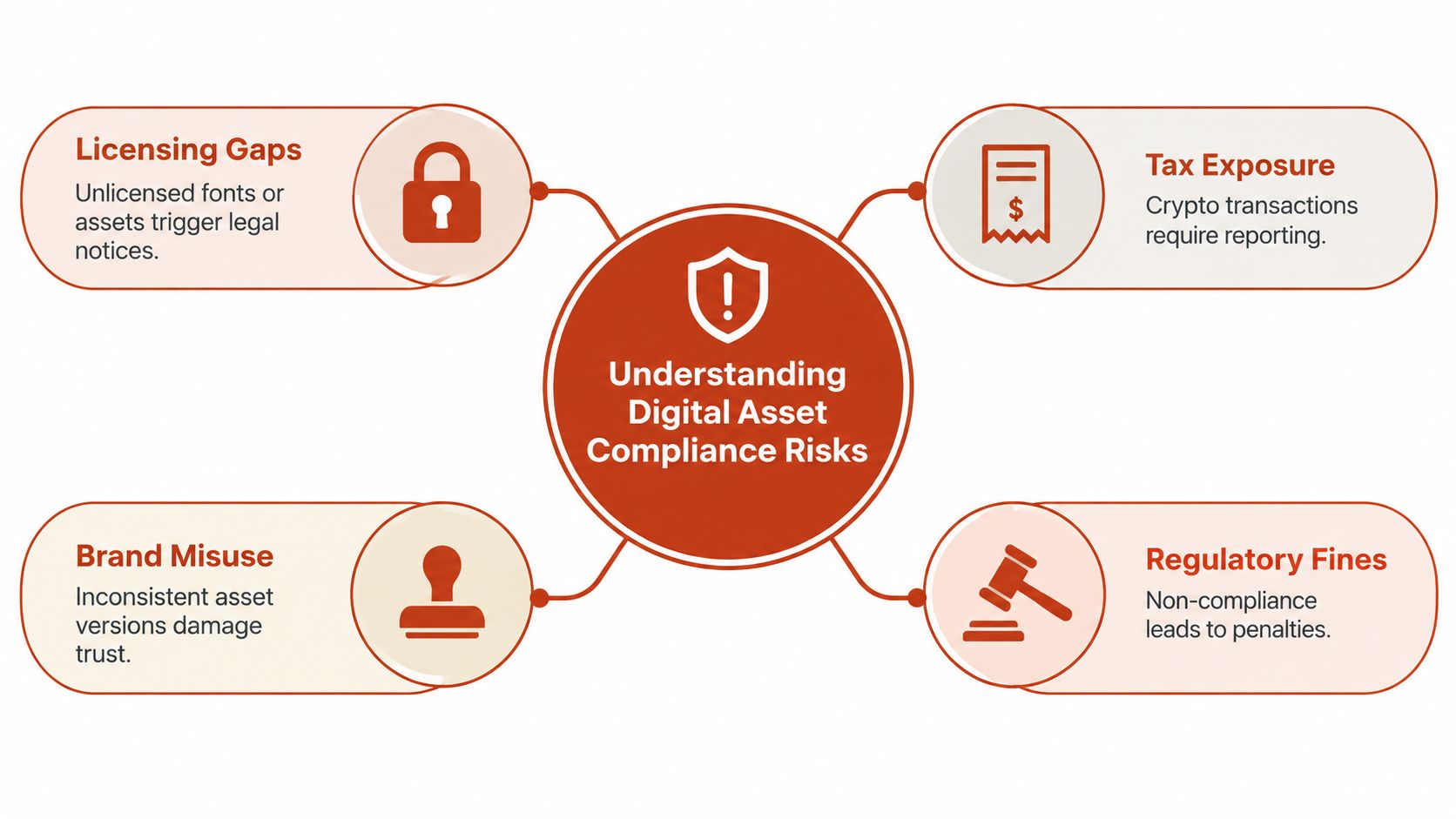
Understanding Digital Asset Compliance Risks
The first mistake teams make is defining digital assets too narrowly. A finance department may hear the term and think of tokens, wallets, exchanges, and blockchain transactions. A design team may think of digital assets as fonts, logos, image files, animation, and brand templates. Both perspectives are valid, and a useful compliance program has to connect them.
A crypto business can fail because it doesn't verify a customer's identity or retain evidence of transaction monitoring. A marketing organization can fail because a designer downloaded a trial typeface, a developer self-hosted it on a production site, and nobody checked whether the license covered web use. The legal consequences differ, but the operational weakness is similar: the organization can't prove what it used, who approved it, or whether the right to use it was still valid.
Practical rule: If an asset appears in a customer-facing product, campaign, document, or transaction workflow, give it an owner, a source, a usage record, and a review path.
The four overlapping risk areas
Licensing gaps arise when teams use an asset outside the rights granted by its license. Font licensing is a common example because desktop and web use often involve different permissions. A file can be legitimately installed on a licensed computer for offline work and still require a separate webfont license when embedded in HTML or CSS.
Tax and reporting exposure can arise from digital-asset activity, particularly when transaction records are incomplete or responsibilities are divided across wallets, exchanges, custodians, and finance systems. The right response depends on the organization's activities and jurisdictions, so teams shouldn't treat a wallet export as a complete compliance record.
Brand misuse occurs when teams use uncontrolled versions of logos, fonts, imagery, or templates. Inconsistent assets can weaken trust and make it difficult to establish which version was approved. That matters during an audit, a dispute, or a regulatory inquiry because the organization needs to connect the published asset to an accountable process.
Regulatory penalties become more likely when firms treat compliance as a policy exercise rather than an operating discipline. A policy that says employees must obtain approval is weak if nobody monitors trading, records exceptions, or investigates suspicious activity.
Why traditional categories aren't enough
Traditional asset registers often separate financial instruments, physical property, software, and marketing materials. Modern organizations operate across all four at once. A tokenized product may sit in a financial workflow, while the interface that presents it relies on fonts, icons, images, analytics scripts, and third-party code.
That creates a shared control problem. Legal needs license evidence. Engineering needs to know what is deployed. Design needs approved sources. Finance needs transaction and ownership records. Compliance needs a defensible trail showing that someone identified the risk, assessed it, and took action.
Teams looking to connect brand governance with broader digital risk can also review this practical discussion of fonts as a business and compliance risk. The central lesson is simple: digital asset compliance protects the whole operating environment, not only the assets that appear on a balance sheet.
The Regulatory Environment and Enforcement Trends
A firm can have a sound product, capable engineers, and willing customers, yet lose market access because its compliance evidence is incomplete. Digital asset compliance has moved from a specialist concern to an operating requirement. In the European Union, MiCA became fully applicable across all 27 EU member states on June 30, 2025, following a transitional period that began in June 2024. The framework established a harmonized rulebook for crypto-asset issuance, custody, and service provision, replacing more fragmented national approaches. Industry sources reported that 57 institutions had obtained MiCA licenses by November 2025, indicating that firms were moving from preparation toward authorization. These milestones are documented in the 2025 crypto compliance review.
For a European business, licensing status affects whether the firm can access the market. AML and counter-terrorist-financing controls, customer due diligence, ongoing reporting, and documented ownership of compliance decisions must function as routine business processes. A policy stored in a legal folder does little if operating teams cannot show how it shaped an approval, transaction review, or escalation.
Enforcement is concentrating on operational controls
The global enforcement picture reinforces that point. In the first half of 2025, AML-related fines and settlements tied to digital assets exceeded $900 million, while reported SEC crypto enforcement penalties fell 97% year over year. That contrast points to stronger pressure on anti-money-laundering controls, rather than attention focused only on broad crypto enforcement. The same foundations recur across regulated operations: identity verification, transaction monitoring, suspicious-activity reporting, sanctions screening, and reliable records. These figures and related U.S. stablecoin developments are covered in the state of digital asset regulation report.
The GENIUS Act established a federal framework for payment stablecoins and brought them under the Bank Secrecy Act. Covered activities therefore involve familiar financial-crime controls, including customer due diligence, transaction monitoring, suspicious-activity reporting, and sanctions screening. A team cannot treat “stablecoin” or “digital asset” as a substitute for control evidence. The classification may change the requirements, but it does not remove the need to demonstrate how those requirements are met.
The regulator's question is rarely only what happened. It's also whether the firm can show who knew, who approved, what evidence was reviewed, and how exceptions were handled.
Font rights follow a similar enforcement logic
Typography presents a parallel compliance problem outside financial regulation. A desktop font license generally covers installation on licensed computers for offline work such as print, logos, static images, and mockups. A webfont license covers embedding the typeface in website code so visitors can render it through HTML and CSS. Foundries may also set desktop pricing by users or devices and web rights by pageviews, so the permissions are not interchangeable. The distinction is explained in this guide to font licensing for desktop and web use.
Using a desktop-licensed font on a website can breach the applicable license. This industry guide to font licensing compliance explains the distinction. Risk rises when teams copy files between design applications, content management systems, advertising tools, and production servers without recording the permitted scope.
Foundries often structure one typeface with separate desktop, webfont, digital advertising, mobile app, ePub, and server licenses, each with its own restrictions. Accidental use does not remove legal, financial, or security exposure. The practical consequences of missing permissions are outlined in this guide to unlicensed font exposure.
The connection is operational. Rights holders can inspect deployed media, source files, and usage patterns. Financial supervisors can inspect transactions, controls, and decision records. In both cases, passive compliance fails when evidence is scattered across teams and systems. The same discipline also applies to navigating defense contractor compliance, where procedures must connect responsibility, evidence, and corrective action. For the business impact of font disputes, review this analysis of font licensing lawsuits in Europe and the United States. This is practical guidance, not legal advice.
Essential Workflows for Auditing Digital Assets
A production release can pass design review and still create a compliance gap. A font may load from a CDN, a plugin, or a third-party service, while a crypto operation may split records across custody systems, transaction platforms, internal ledgers, and investigation tools. The audit starts by reconciling what the team intended to use with what is deployed.
Create a relationship between each asset, its location, its owner, its permitted use, and the evidence supporting that use. This turns a scattered collection of files and records into an auditable control process.
Build the inventory before testing rights
Create one register for the relevant digital estate and give every entry a meaningful identifier. For typography and creative assets, capture:
- Asset identity: Record the typeface, image, logo, template, file format, and version.
- Deployment location: Distinguish self-hosted files, CDN-loaded resources, design-library files, PDFs, applications, and third-party dependencies.
- Business owner: Name the team accountable for approving use and answering questions.
- License evidence: Store the agreement, invoice, account record, terms, permitted channels, and restrictions.
- Review status: Mark the item as verified, unclear, expired, restricted, or requiring replacement.
For financial digital assets, add operational fields that make the record usable during an investigation. Record the wallet ID, custodian, transaction hash, policy reference, and reviewer sign-off in the same register row, so evidence can be exported without reassembling logs. Supervisors increasingly expect on-chain events to sit alongside risk assessments, policy documents, testing results, control evidence, and documented decision ownership, as reflected in these digital-asset risk and regulatory expectations.
Test, classify, and remediate
Once the register is complete, verify the right rather than merely the file. For a font, check whether the license covers the actual channel, domain, application, audience, and deployment method. For a token or wallet workflow, document the regulatory category, controlling party, monitoring requirement, and evidence location. Classification belongs in a recorded decision, not in the memory of the person who acquired the asset.
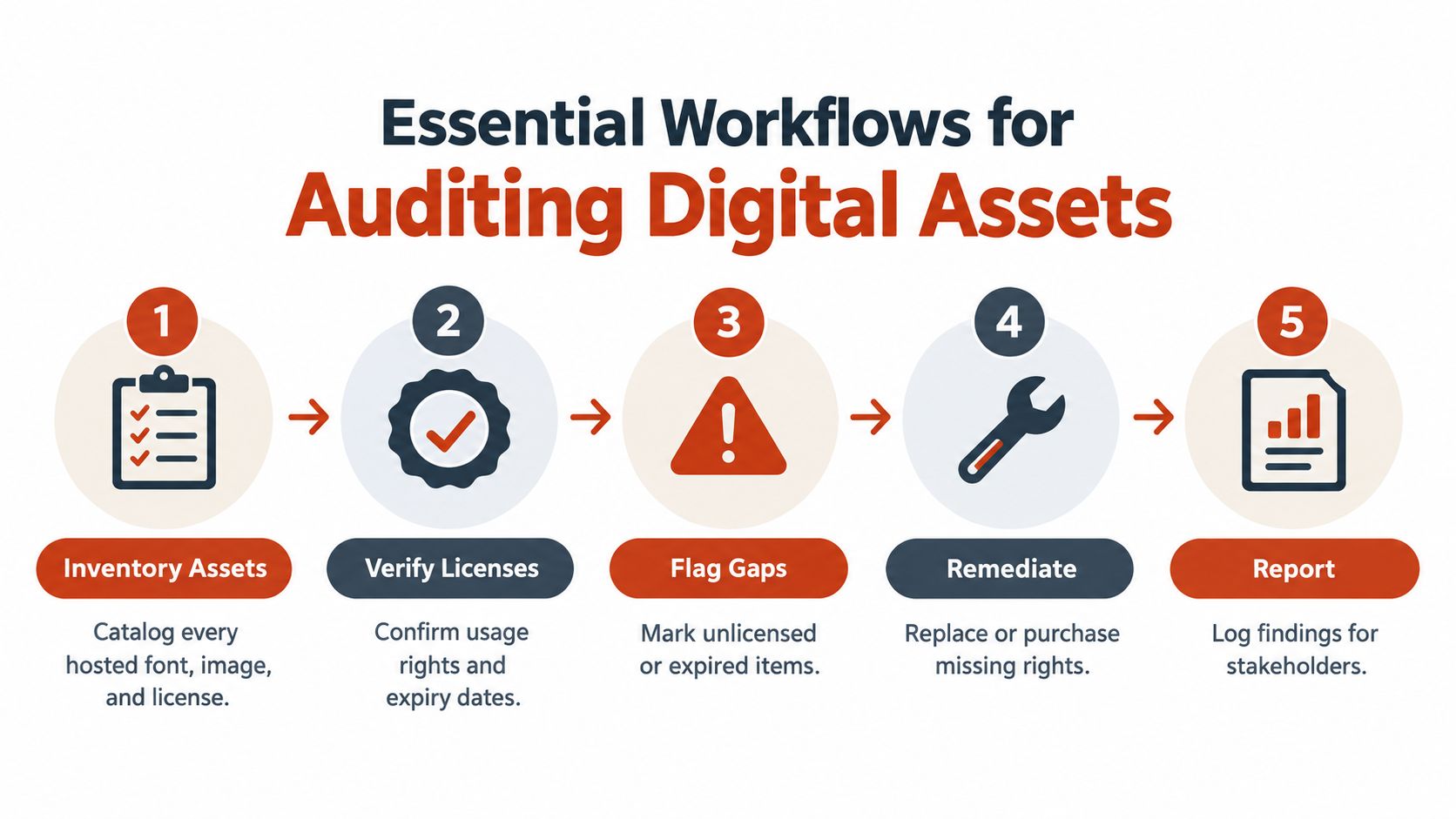
Use this sequence:
- Discover what is present in production and working files.
- Match each item to its source and license or control requirement.
- Flag uncertainty, expiry, missing evidence, unauthorized deployment, and ownership gaps.
- Remediate by obtaining rights, replacing the asset, restricting access, or escalating the issue.
- Report the result to legal, engineering, design, finance, and accountable management.
Keep the original finding, decision, responsible person, action taken, and completion evidence together. Teams preparing for broader reviews can apply these Vision audit readiness tips to organize evidence and ownership. For a more detailed typography-focused method, use this digital asset auditing framework. This guidance is informational, not legal advice.
Manual Checks vs. Automated Compliance Tools
Manual review remains useful, but it breaks down when the digital estate changes faster than the audit calendar. A developer can inspect browser tools, identify a loaded font file, trace its source, compare it with a license folder, and ask legal to interpret the terms. That approach can work for a small, stable site. It becomes difficult when pages, campaigns, subdomains, PDFs, applications, and client environments change regularly.
The problem isn't that people can't perform the work. The problem is that manual checks depend on memory, repeated effort, and consistent handoffs. A reviewer may confirm the homepage and miss a campaign microsite. A designer may have a valid desktop license while the developer deploys the same family as a webfont. A legal team may receive a screenshot without the source file, deployment path, or relevant license version.
Where manual review earns its place
Manual checks are appropriate when the question requires judgment or context. A human should interpret ambiguous license language, decide whether a business use falls within a negotiated agreement, assess materiality, and approve a remediation plan. Manual review is also valuable for investigating exceptions discovered by a scan.
Use it deliberately for:
- New acquisitions: Confirm the license before an asset enters a shared library.
- High-risk launches: Review the campaign, product, or document that carries unusual legal or commercial importance.
- Exceptions: Investigate an asset that doesn't match the recorded owner, source, or permission.
- Final decisions: Have legal or compliance approve interpretations that could affect rights, disclosure, or market access.
Manual review doesn't provide dependable continuous coverage by itself. It usually finds what a reviewer knows to look for, at the time the reviewer performs the check.
What automation changes
Automated auditing can inspect live URLs, PDFs, images, and zipped font sets, identify typefaces, associate them with foundries and license tiers, and flag possible trial copies, expired rights, or self-hosted files that conflict with stated terms. It can also produce reports for different audiences, such as a PDF for legal review, a CSV for operations, and structured output for engineering workflows.
A dedicated service such as Font Checker Pro fits this narrow control problem by scanning digital typography, checking usage signals, and supporting recurring reviews and alerts. It shouldn't replace legal interpretation. It gives the human reviewer a more complete set of findings and reduces the chance that an overlooked page or file remains outside the review.
| Review method | Useful for | Main limitation |
|---|---|---|
| Manual inspection | Judgment, exceptions, negotiated terms, focused spot checks | Slow to repeat and dependent on reviewer coverage |
| Automated scanning | Discovery, recurring monitoring, evidence collection, deployment checks | Cannot replace legal interpretation or ownership decisions |
| Combined workflow | Continuous discovery plus accountable decisions | Requires clear roles and an escalation process |
The safer operating model is therefore not “manual or automated.” It is automated discovery followed by human validation. This comparison of manual checks and automatic font scanning reflects the practical distinction: tools can identify signals quickly, while people decide what the signals mean and what the organization should do.
Monitoring, Incident Response, and Continuous Compliance
Compliance changes when the underlying asset changes. A new website release can introduce a font. A campaign can add a licensed image. An employee can open a personal crypto account that conflicts with an internal policy. A custody provider can change its controls or reporting format. Treating the annual audit as the control means the organization discovers problems after exposure has already occurred.
A continuous program connects monitoring to ownership. Each asset or activity should have a review frequency, a responsible person, an escalation route, and a record of the outcome.
Design the monitoring loop
Recurring scans should cover the places where assets appear, not only the main production domain. Include campaign pages, regional sites, PDF libraries, design repositories, mobile releases, and other approved environments. For financial activity, align monitoring with the organization's transaction flows, employee dealing controls, sanctions processes, and suspicious-activity escalation procedures.
Set alerts around events that require action:
- License changes: A right expires, a seat limit is reached, or a permitted channel changes.
- Deployment changes: A new self-hosted file, page, or dependency appears.
- Control failures: A review is overdue, evidence is missing, or an exception has no owner.
- Employee activity: Trading or conflicts fall outside the approved process.
- Record anomalies: A transaction, approval, or investigation lacks supporting documentation.
Employee activity deserves more attention than many programs give it. A 2026 survey found that 63% of firms globally allow employees to trade crypto without pre-approval, 79% don't plan to introduce a crypto trading policy in 2026, and only 37% have a formal employee crypto-trading policy. More than 50% cited lack of visibility as the main monitoring challenge, while 75% said they were somewhat or very unprepared to manage digital assets, tokenisation, and prediction-market risks. These findings are reported in coverage of crypto compliance gaps and internal monitoring.
Respond without destroying evidence
When a violation appears, don't immediately delete the file and close the ticket. Preserve the finding, capture the deployed state, identify the owner, restrict further use where appropriate, and involve legal or compliance before making statements to a rights holder or regulator.
A proportionate response often follows this order:
- Contain: Stop new deployment or publication if continued use increases exposure.
- Preserve: Save the scan result, source reference, relevant file, license record, and decision history.
- Assess: Determine scope, duration, affected channels, and whether other assets share the same problem.
- Remediate: Obtain the required right, replace the asset, correct the control, or document an approved exception.
- Verify: Re-scan or re-test after the fix and attach evidence to the incident.
- Learn: Update procurement, onboarding, code review, employee-trading, and asset-register procedures.
For crypto operations, end-to-end evidence should join on-chain events with external control records. For custody environments, the IEEE 3275.01 standard covers areas including account and identity management, key generation and storage, transaction authorization, multi-signature and threshold mechanisms, and interoperability across blockchain networks. Those technical controls support custody integrity and auditability, but teams still need policies, testing, ownership, and documented decisions around them. This practical material on building audit trails for crypto offers useful context for structuring that evidence.
The same principle applies to typography. An audit trail for digital assets should show what was found, when it was found, who assessed it, and how the organization resolved it.
Key Takeaways for Legal and Operations Teams
Small teams aren't exempt from digital asset compliance risk. They often have fewer approval layers, more shared accounts, less separation between design and development, and a greater dependence on individual memory. Those conditions can make an unauthorized font, unreviewed wallet, or undocumented exception harder to detect, not less important.
Compliance also isn't a legal department handoff. Legal can interpret a license or regulatory obligation, but it may not know what a developer deployed, which campaign file a designer copied, or how an employee executed a transaction. Developers can identify the source of a file, but they may not know whether the organization has permission to use it. Designers can select an approved typeface, but they need a controlled library and a clear procurement process.
Assign ownership across the workflow
A workable operating model gives every team a specific responsibility:
- Design and brand teams: Use approved assets, retain acquisition evidence, and escalate unclear rights before publication.
- Developers and engineering: Track deployed resources, distinguish self-hosted from externally loaded files, and support automated checks in release workflows.
- Legal and compliance: Interpret obligations, approve exceptions, define escalation thresholds, and maintain policy language.
- Finance and operations: Reconcile purchases, subscriptions, wallets, custody records, and reporting evidence.
- Management: Accept or remediate residual risk and ensure owners have time and authority to act.
MiCA's full application across the EU and the AML-focused enforcement environment show why crypto firms need a control framework that can withstand scrutiny. The parallel font problem shows why the same discipline belongs in the brand ecosystem. Don't assume a familiar file is harmless because it has been used for years. Don't assume a token is outside a rule because its label sounds technical. Classification, evidence, and accountable decisions matter more than informal descriptions.
A practical control checklist
Start with the highest-risk gaps rather than attempting a perfect transformation immediately.
- List the estate: Identify websites, applications, PDFs, design libraries, wallets, custodians, transaction systems, and third-party dependencies.
- Name the owners: Assign a person or team to every material asset and control.
- Verify the scope: Check whether rights and controls cover the actual channel, jurisdiction, activity, and deployment method.
- Record the evidence: Store agreements, approvals, monitoring results, investigations, tests, and remediation proof in a retrievable location.
- Automate discovery: Use recurring checks where manual inspection would leave predictable blind spots.
- Test response: Confirm that teams know how to contain, preserve, assess, remediate, and report an incident.
- Review classification: Revisit tokenized instruments, wallet-based holdings, stablecoins, employee trading, and new venue types as the operating model changes.
This approach makes compliance measurable without pretending that every decision can be reduced to a scan result. The strongest programs combine technology with judgment, clear ownership, and evidence that another person can understand later.
Font Checker Pro scans live URLs, PDFs, images, and zipped font sets to identify typefaces, foundries, license tiers, and possible licensing gaps, then provides exportable reports for legal, operations, and engineering workflows. Use Font Checker Pro to add recurring typography checks and a defensible audit trail to your broader digital asset compliance process.