A redesign can fail in two places at once. The new type system looks perfect in design reviews, but mobile users wait for text to appear, the headline shifts when the branded face arrives, and Core Web Vitals deteriorate after launch. Then a type foundry asks the company to prove that its web license covers every domain, weight, and delivery method in production.
That combination is more common than many teams expect. Web font performance is a front-end engineering concern, while font licensing is a legal and procurement concern, but both depend on the same files, CSS declarations, hosting choices, and deployment habits. Treating typography as a static creative asset leaves performance regressions and compliance gaps hidden in the same release.
The Hidden Cost of Beautiful Typography
A brand team launches a polished redesign with a distinctive display face, several text weights, and a variable font for responsive layouts. The agency has exported the files, engineering has self-hosted them, and the site works on fast office connections. A month later, field data shows that the primary heading arrives late on mobile, the fallback font changes its dimensions during the swap, and a type foundry requests documentation for the web use.
Nobody made an obviously reckless decision. The designers chose the right visual language. The developers used a modern file format. The procurement team had bought font files for the brand rollout. The failure came from treating those decisions as separate. A desktop purchase may cover installed use for static outputs such as logos, PDFs, and print materials, but it doesn't necessarily cover hosting or embedding the same typeface on a website, as explained in why fonts are more than a creative choice.
The technical side creates its own traps. Every additional family, weight, style, and language range can add work to the browser. A font request may sit behind a stylesheet, wait for a connection, compete with the page's largest visual element, and then cause a visible reflow when the final face replaces the fallback. The result isn't just a slower audit score. Users may see invisible text, a flash of unstyled text, or controls that move after they start reading.
One asset, several owners
Designers choose the typeface and define the intended hierarchy. Developers decide how files are subset, loaded, cached, and served. Legal and compliance teams verify whether the license covers the actual deployment. Agencies often inherit all three responsibilities when they receive incomplete brand packages from a client.
A practical workflow gives each group a question to answer:
- Design: Which families and weights are necessary for the interface, and which are decorative options?
- Engineering: Which files are requested on the critical path, and what happens if they arrive late?
- Compliance: Does the agreement cover web embedding, the relevant domains, traffic scope, server arrangement, and language or weight variants?
Practical rule: A converted file isn't automatically an authorized file. Performance work changes delivery, not ownership rights.
The financial exposure can include retroactive licensing fees, demands to stop using the typeface, copyright claims, breach of contract, remediation, and rebranding costs. Those outcomes depend on the agreement and the facts, but the risk is serious enough to make font inventory part of release governance. This article is informational, not legal advice. A qualified lawyer should review the applicable end-user license agreement and business circumstances.
Measuring Font Impact on Core Web Vitals
A font can look small in the network panel and still delay the page users see. The browser must discover the stylesheet, match the relevant @font-face rule, request the resource, decode it, and choose how to render text while the request is pending. If those steps form a sequential chain, a modest file can create a noticeable delay.
The 2025 HTTP Archive Web Almanac font data found web fonts on roughly 88% of websites, up from about 87% in 2024. WOFF2 accounted for about 65% of font file requests on both desktop and mobile pages. Median font files measured about 35 to 36 KB, while the 90th percentile reached 116 KB on desktop and 115 KB on mobile. The gap shows why median transfer size can hide a serious burden from heavier assets.
Performance work also needs a compliance checkpoint. Self-hosting, subsetting, converting, or combining font files changes how an asset is deployed, even when its visual appearance stays the same. Record the source and resulting files during the performance audit, then confirm that the optimization workflow is permitted before shipping it. A faster font pipeline can create a licensing issue if the deployed asset or delivery arrangement was never reviewed.
What to measure
Payload size matters, but it is only one part of the cost. A large family may include glyph ranges the page never uses, while several small files can create more connection and parsing work than one carefully planned resource.
FCP records when the first visible content appears. Font requests can delay it when text is withheld or when the browser must resolve font-related CSS before presenting meaningful content.
LCP records when the largest visible element becomes available. On editorial, marketing, and product pages, that element is often a heading or text block whose dimensions and paint depend on the selected face.
CLS captures unexpected movement. If fallback metrics differ from the final font, line breaks, block height, or nearby control positions can change when the swap completes.
The loading behavior has two familiar failure modes. FOIT, or Flash of Invisible Text, hides text while the browser waits for the web font. FOUT, or Flash of Unstyled Text, shows a fallback face first and replaces it later. FOUT usually exposes content sooner, but a poor metric match can still cause a jarring transition and layout shift.
The scale of the problem
Independent measurement across 9.5 million sites found that pages loading externally hosted font libraries were good on LCP 63% of the time on mobile, compared with 72% without them, a 9-point gap. Sites using a font script were good on LCP 64.4% of the time, compared with 73.4% without such a script, another 9.0-point penalty. These historical figures do not diagnose every implementation, but they show a real-world association between font-loading code and weaker mobile outcomes (the web fonts and Core Web Vitals data).
Practical audit guidance associates a single unoptimized font with median FCP degradation of 370 to 890 ms. Late font swaps have also been associated with CLS increases of 0.18 to 0.41 (the Core Web Vitals font checklist). Use those figures as investigation prompts, not as a reason to remove every branded face. Identify the font affecting the first viewport, check whether it delays the LCP element, compare fallback metrics, and verify that any optimized derivative remains approved for deployment.
A monitoring workflow should connect lab traces with field observations, request timing, font payloads, and visual stability. The GoReplay performance insights outline a practical framework for collecting and interpreting those signals, so teams can compare controlled tests with behavior from real users.
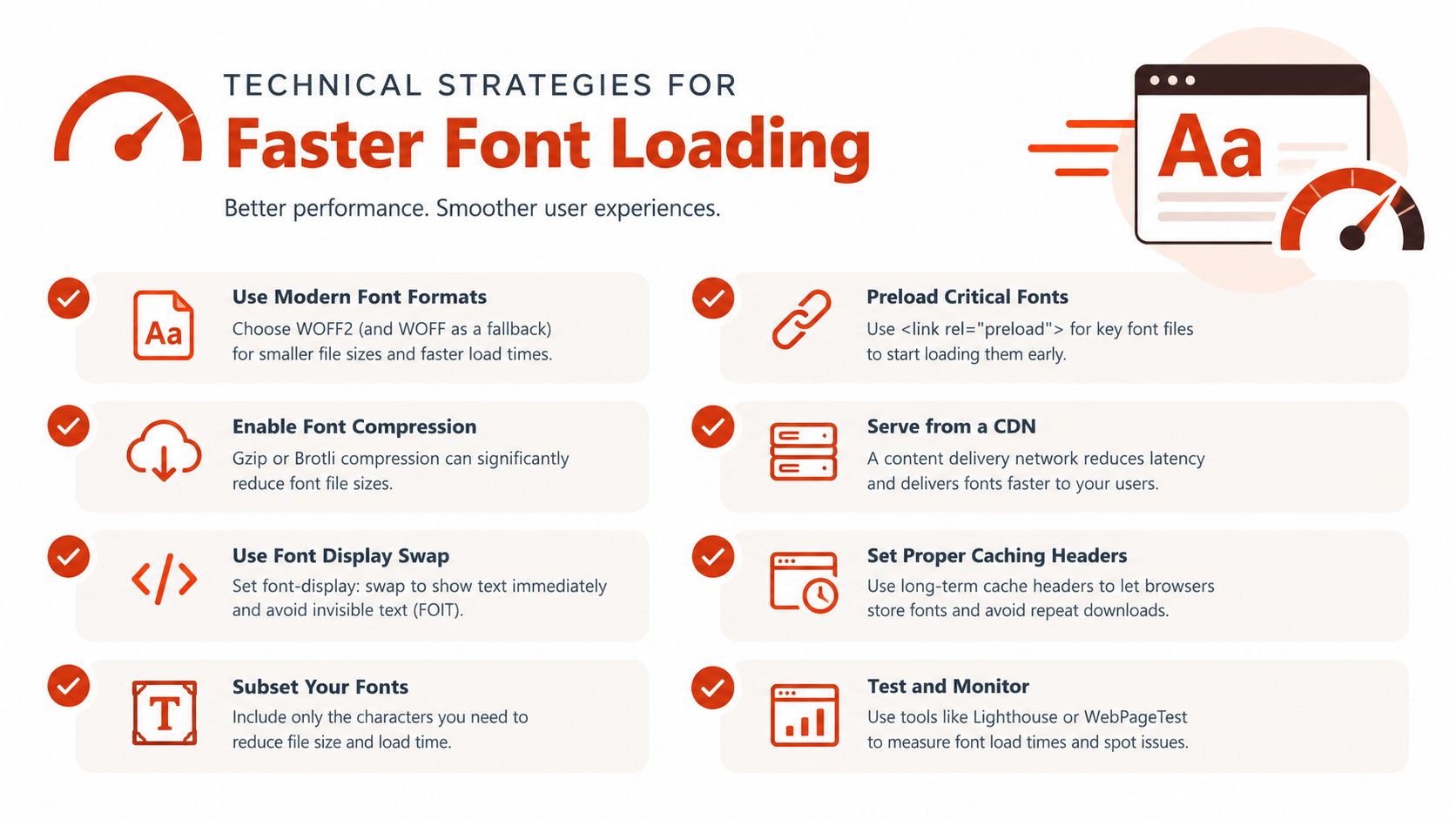
Technical Strategies for Faster Font Loading
A page can meet its design brief and still waste the first viewport on font work. Start by identifying the family, weight, and script used above the fold. Optimize that request path before processing an entire brand library.
Choose the right files
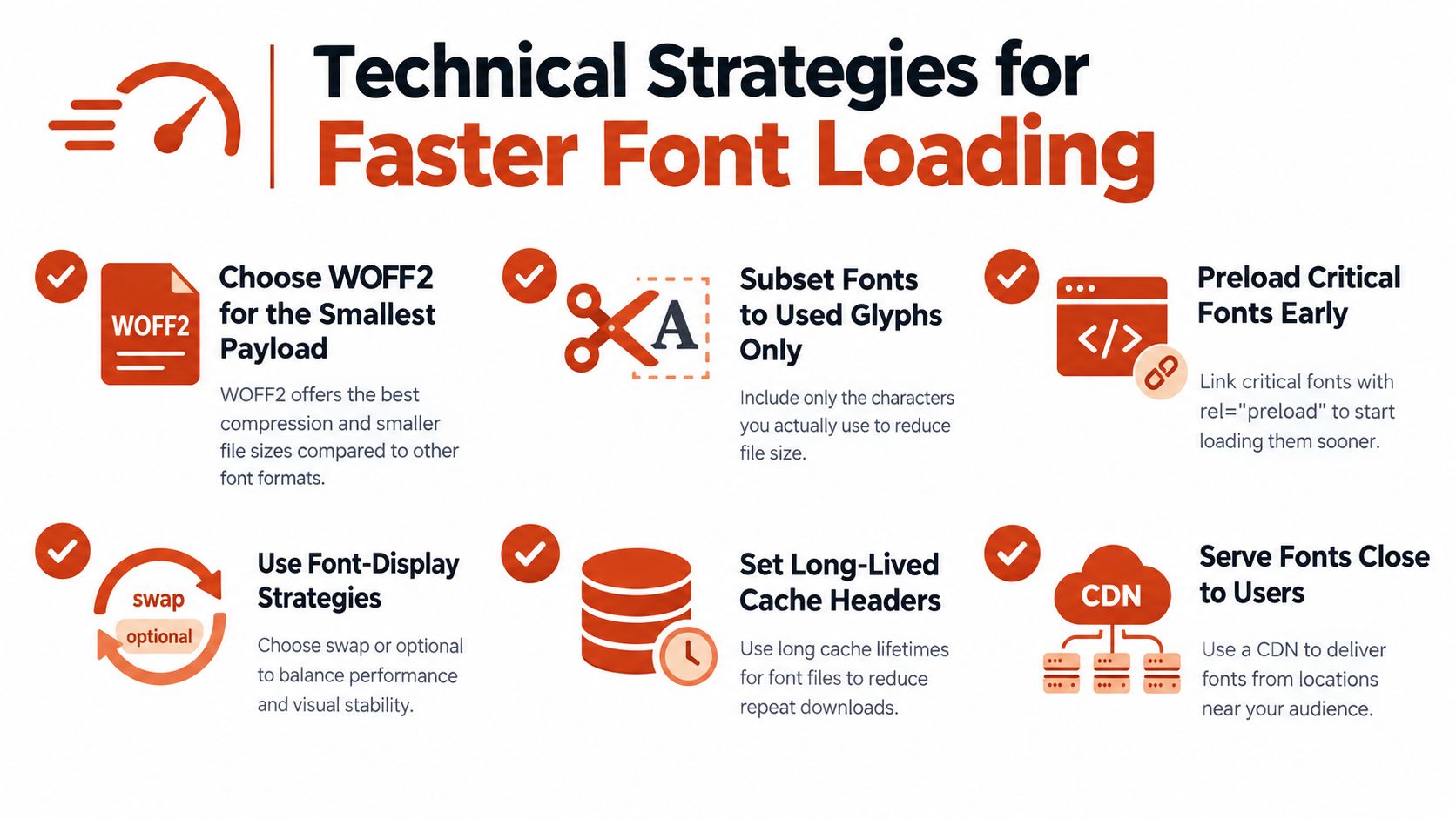
Use WOFF2 as the default web delivery format when browser support and project requirements permit it. A controlled academic benchmark based on 500 trials per format measured a median document-load time of 161 ms for WOFF2, compared with 171 ms for the next-best version, and recorded the lowest CPU consumption at 27.89 million cycles. It also reported a statistically significant difference in loading time across formats, F(3,1996)=1138, p<2.2e−16. Those results support WOFF2 as a practical way to reduce transfer and processing overhead (the academic font-format benchmark).
Format choice does not remove the need for device testing. Research comparing OTF, TTF, WOFF, and WOFF2 found meaningful differences in client-side resource consumption, with WOFF2 generally performing best except for memory allocation (the font-format resource comparison). Large families, multilingual coverage, and low-power devices can change the result. Measure CPU, memory, and energy as well as transfer size.
Remove what the page doesn't use
Subset fonts by language, character range, and interface requirements. A Latin-only marketing page should not download a multilingual family, and a page using regular and semibold text should not request every available weight. Keep the original licensed files in a controlled archive. Document the source, generated subset, supported language range, and production owner.
Subsetting also creates an audit trail. Record the permitted use and the transformation applied to each output, so a smaller file remains traceable to an approved source. The font subsetting guide for faster and safer websites provides a practical framework for formalizing that process.
Control rendering behavior
A typical declaration is:
font-display: swap;
The browser can display a fallback while the web font loads, reducing the risk of invisible text. optional may fit a decorative face that is not required for comprehension, because the browser can leave the fallback in place when the download is not completed. Neither setting prevents layout shifts. Choose fallback fonts with similar width and vertical metrics, then test metric overrides such as size-adjust, ascent-override, and descent-override.
Improve discovery without overloading the page
Preload only a critical font, and match the preload attributes to the resource requested by the stylesheet. An unused preload consumes an early connection opportunity and can compete with more important content. Limit the preload list to fonts that affect initial rendering.
Variable fonts can consolidate axes such as weight or width into one flexible resource. They may reduce duplicated files, but a variable font is not automatically smaller than a carefully subset static face. Inspect its supported ranges and test the delivered file on constrained devices.
Finally, apply long-lived cache headers when filenames are immutable, serve files from infrastructure close to users, and avoid unnecessary CSS @import chains. WOFF2, subsetting, preload, rendering behavior, caching, and geographic delivery must be evaluated as one request path. A smaller font can still provide little visible improvement if stylesheet discovery and font fetching remain sequential.
Navigating Web Font Licensing and Legal Risks
Self-hosting is a deployment decision, not a license grant. Converting an OTF or TTF into WOFF2 changes the package delivered to the browser, but it doesn't change the rights attached to the typeface. A desktop license commonly covers installing a font on a computer for static outputs, while web and app licenses address different forms of embedding and distribution. Those categories aren't interchangeable.
The same distinction applies to a font obtained from a public library or included in a design handoff. “Free” can describe price, access, or a particular permission set. It doesn't remove the need to read the applicable license, preserve notices, comply with redistribution conditions, or confirm that the intended web use fits the stated terms.
Where teams create exposure
Performance projects often increase legal risk because developers make local copies. A team may download a font from a hosted service, convert it, subset it, rename the generated files, and place them on a company CDN. From an engineering perspective, that may improve control over requests and privacy. From a compliance perspective, the team has created a new distribution path that needs to be covered by the agreement.
Check the following before deployment:
- License category: Confirm that the agreement covers web embedding rather than only desktop installation or application distribution.
- Scope metrics: Look for limits based on domains, monthly page views, server instances, users, or other measures.
- Modification rights: Verify whether conversion, subsetting, renaming, and removal of metadata are permitted.
- Environment coverage: Include staging, production, campaign microsites, client domains, and regional deployments where relevant.
- Record retention: Store invoices, EULAs, renewal records, file hashes, and the relationship between purchased rights and deployed assets.
Treat “already approved” as a hypothesis
Brand approval doesn't prove technical or legal approval. A typeface selected years ago may have been licensed for print but never for a public website. An agency may have supplied a trial copy, or a contractor may have added a font without recording its origin. A recurring audit can reveal those gaps before an external inquiry does.
Unauthorized use can lead to retroactive licensing fees, cease-use demands, copyright infringement claims, breach of contract, and remediation or rebranding costs, depending on the rights holder's claims and the governing agreement (enterprise font licensing compliance guidance). This is informational, not legal advice. Escalate ambiguous terms to counsel instead of interpreting an EULA from a filename or a download page.
For teams reviewing current deployments, the 2026 web font license compliance guide provides a useful checklist for separating inventory work from legal interpretation.
Evaluating Delivery and Hosting Architectures
There isn't one universally correct font architecture. A third-party delivery service may simplify distribution and caching, self-hosting may improve control over requests and data flows, and a specialized font API may provide operational convenience. Each option still requires an inventory of what loads, where it loads, and whether the license permits that arrangement.
Network behavior often matters more than raw file size. The W3C Progressive Font Enrichment evaluation found in both trials that bandwidth wasn't the limiting factor, while the round-trip time for a single request was the important variable. That makes request count, connection reuse, discovery order, and geographic distance central parts of web font performance.
Incremental delivery has the same trade-off. The relevant specification explains that incremental loading exchanges fewer transferred bytes for more network requests and added request-processing latency. Each augmentation typically requires at least one round trip, so a theoretically smaller payload can perform worse when the request pattern becomes chatty.
| Architecture | Performance Impact | Privacy & Compliance | Best Use Case |
|---|---|---|---|
| Third-party CDN | Can provide geographically distributed delivery and established caching, but adds an external dependency and request path. | Review data flows, domains, vendor terms, and whether the font license covers the provider's delivery model. | Teams that need managed distribution and accept an external delivery dependency. |
| Self-hosted infrastructure | Gives direct control over caching, preload behavior, subsets, and request timing. Results depend on the quality and location of the delivery stack. | Often simplifies data-flow review, but the organization remains responsible for file provenance, license scope, and access controls. | Teams with strict privacy requirements or an established asset delivery platform. |
| Specialized font API | Can reduce operational work and expose managed font selection or delivery features. | Verify provider terms, processing locations, allowed domains, and the underlying font rights. | Teams that value managed typography operations and can accept API-level dependency. |
Make the decision with evidence
Measure the critical path from stylesheet discovery to text paint. Compare request count, cache behavior, fallback rendering, LCP, CLS, and failure behavior on representative devices and networks. Then give compliance the exact production architecture, not just the font family name.
Self-hosting doesn't automatically make a site faster, and a CDN doesn't automatically make it compliant. The right choice is the one that meets the performance budget, privacy requirements, operational capabilities, and documented license scope together. Teams considering local copies of hosted fonts can use this practical self-hosted font guide as a starting point for that review.
Automating Typography Audits and CI Monitoring
A font inventory maintained in a spreadsheet is already out of date when a new landing page, campaign asset, or vendor widget reaches production. Manual checks also miss the relationship between the declared family, the requested file, the fallback stack, and the license record. Typography needs the same continuous controls as other production dependencies.
Scan the rendered result
A useful audit begins with the live URL, not only the repository. Inspect the rendered page and record:
- Detected families and files: Identify every face requested by the page, including weights, styles, variable files, and self-hosted assets.
- Loading behavior: Capture request timing, payload, unused glyph ranges, FOUT or FOIT exposure, and the effect on visual stability.
- Fallback hygiene: Check whether system fallbacks preserve approximate width and vertical metrics when the branded face is delayed.
- Rights evidence: Match deployed files to foundry, license tier, permitted domain, scope limits, renewal status, and source documentation.
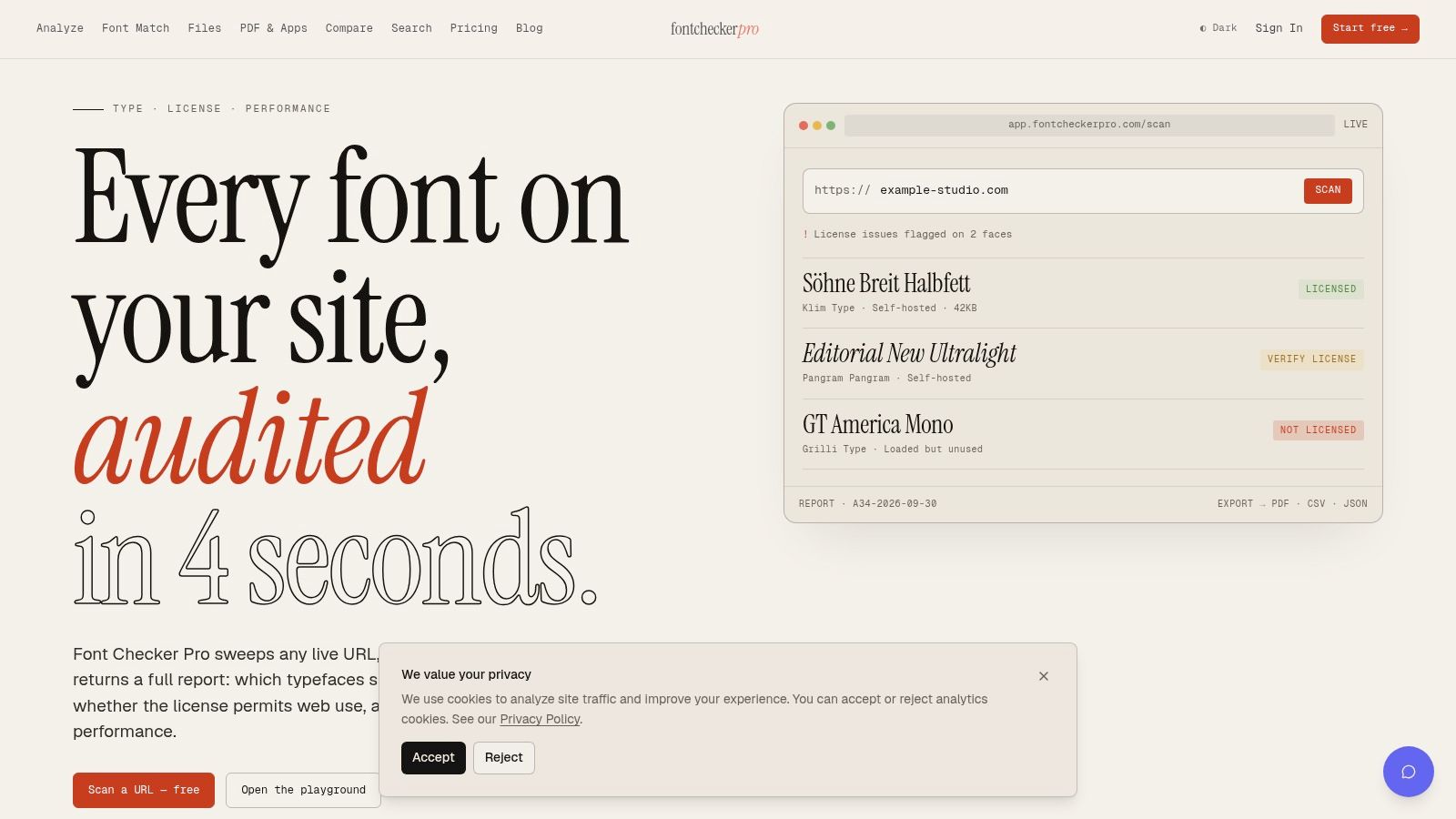
Font Checker Pro can scan live URLs, PDFs, images, or zipped font sets and return an exportable typography report. Its stated workflow detects typefaces, attributes foundries and license tiers, flags trial copies, expired rights, and self-hosted files that violate terms, and benchmarks payload, unused glyphs, and FOUT or FOIT impact. It also supports recurring scans, Slack or email alerts, PDF, CSV, and JSON reports, with a REST API on Pro and Enterprise plans. This article is informational, not legal advice, and automated flags still need human review where the license language is ambiguous.
Put controls in the release path
Run a typography audit against important templates during CI and after deployment. Fail or warn on conditions that the team has defined in advance, such as an unapproved family, an unexpected weight, a new external request, a payload outside the performance budget, or a license renewal approaching its deadline.
The REST API guide for font audits and compliance is relevant when engineering teams want to pass scan results into existing build, ticketing, or governance workflows. Store the report with the release artifact so legal teams can later see what was deployed, when it was checked, and which owner accepted any exception.
Governance insight: The most useful alert isn't “font found.” It's “font found, performance changed, and no approved license record matches the deployed asset.”
Schedule recurring production scans as well. CI catches repository changes, but it may not catch a CMS template, agency update, injected widget, or CDN asset added outside the main application. Pair automated detection with a named owner, an escalation route, and a documented decision for every exception.
Building a Sustainable Typography Workflow
Fast, compliant typography comes from a shared operating process, not a last-minute asset cleanup. Designers should specify the required families, weights, scripts, and fallback intent. Developers should produce documented WOFF2 subsets, define rendering behavior, test metric compatibility, and monitor the critical path. Legal and procurement should confirm web rights, scope, modification permissions, and renewal obligations before production deployment.
Keep a simple chain of evidence for every deployed face:
- Select: Record why the typeface and weights are needed.
- License: Store the agreement and confirm that it covers web embedding and the intended architecture.
- Prepare: Generate permitted subsets and optimized files without losing source provenance.
- Deliver: Configure discovery, caching, fallback behavior, and request priority.
- Verify: Measure payload, FCP, LCP, CLS, and font-loading behavior on representative pages.
- Monitor: Recheck live URLs and alert on new files, changed performance, or rights lapses.
The strongest teams don't frame design and compliance as opponents. They use a smaller, intentional font system, preserve the brand where it matters, and make exceptions visible to everyone who owns the release. WOFF2 and subsetting help, but neither replaces testing or licensing review. Self-hosting can improve control, but it creates an asset trail that must remain defensible.
Typography should be governed like any other production dependency. Build the record before launch, test the experience under constrained conditions, and keep checking after the site changes.
Font Checker Pro can scan live pages and font packages for deployed typefaces, payload, unused glyphs, FOUT or FOIT behavior, and licensing signals, then produce reports for engineering, operations, and compliance workflows. Visit Font Checker Pro to audit your current font stack and establish a repeatable review process before the next redesign reaches production.